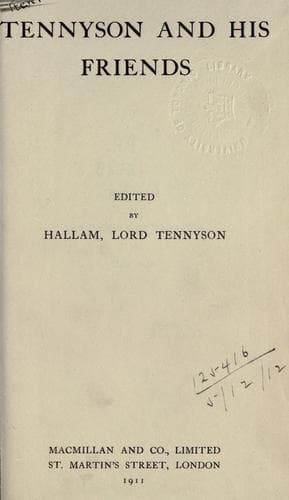
Tennyson, Alfred Tennyson, Baron, 1809-1892 -- Friends and associates
In 1885, being then in his seventy-sixth year, Lord Tennyson published
"Tiresias," preluding with the verses to E. FitzGerald, so vigorous in
tone and so finely wrought, with their rhymes ringing true to the
expectant ear like the chime of a clear bell. Some years before, he had
paid a passing visit at Woodbridge to "the lonely philosopher, a man of
humorous melancholy mark, with his gray floating locks, sitting among his
doves.... We fell at once into the old humour, as if we had been parted
twenty days instead of so many years." It is a rarity in modern life that
two such men as Tennyson and FitzGerald, whose mutual friendship was never
shaken, should have met but once in some twenty-five years, although
divided by no more space than could be traversed by a three hours' railway
journey. "Tiresias" was soon followed by "Locksley Hall: Sixty Years
After"; then, in 1889, came "Demeter" and other poems; until, in 1892, the
volume containing the "Death of Œnone" and "Akbar's Dream" closed the
long series of poems which had held two generations under their charm. One
line in the second "Locksley Hall" its author held to be the best of the
kind he had ever written:
Universal ocean softly washing all her warless isles;
though in my poor judgment the harmony seems marred by the frequent
sibilants, which vex all English composers[97]; and the suggestion that
the sea would become stormless when the land should be at peace may be
thought overbold.
It was but seasonable that his later poetry should have been tinged with
autumnal colouring. The philosophic bent of his mind had necessarily grown
with increasing years; its range had been widened by constant assimilation
with the scientific ideas of the day, with social and political changes;
but as far horizons breed sadness and wistful uncertainty, so his later
verse leans more toward the moral lessons of experience, toward
reflective and retrospective views of life and character. In poetry, as in
prose, the sequel to a fine original piece has very rarely, if ever, been
successful; though the second part, when it follows the first after a long
interval, often exhibits the special value that comes from alteration of
style and the natural changes of mood. Tennyson himself thought that "the
two 'Locksley Halls' were likely to be in the future two of the most
historically interesting of his poems, as descriptive of the tone of the
age at two distant periods of his life." In my opinion, the interest is
less historical than biographical, in the sense that the second poem takes
its deeper shade from the darkening that seems to have overspread his
later meditations. For the interval of sixty years had, in fact, brought
increased activity and enterprising eagerness to the English people; and
the gray thoughts of the sequel, the heavier feeling of errors and perils
encompassing the onward path toward the remote ideal, are the Poet's own.
He employed them, it is true, for the dramatic presentation of old age,
Public-domain text, read in full here on John Shaqi.
Reviews
Reviews
No reviews yet
Be the first to share your thoughts on this work.
Elsewhere in the archive
Join the Discussion
Join the discussion
Sign in to leave a comment or review.
Sign InorCreate an account