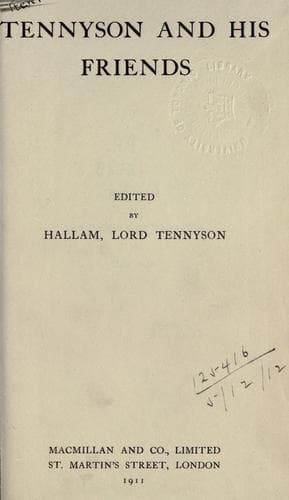
Tennyson, Alfred Tennyson, Baron, 1809-1892 -- Friends and associates
The final chapter of the _Memoir_ gives, briefly, some sentences from his
last talks, and describes a peaceful and noble ending. He found his
Christianity undisturbed by jarring of sects and creeds; but he said, "I
dread the losing hold of forms. I have expressed this in my 'Akbar.'" The
welfare of the British Empire, its expansion and its destiny, had been
from the beginning and were to the end of his poetic career matters of
intense pride and concern to him. When, in September 1892, he fell
seriously ill, and Sir Andrew Clark arrived, the physician and the patient
fell to discussing Gray's "Elegy"; and a few days later, being much worse,
he sent for his Shakespeare, tried to read but had to let his son read for
him. Next day he said: "'I want the blinds up, I want to see the sky and
the light.' He repeated 'The sky and the light.' It was a glorious
morning, and the warm sunshine was flooding the weald of Sussex and the
line of South Downs, which were seen from his window." On the second day
after this he passed away very quietly. The funeral service in Westminster
Abbey, with its two anthems--"Crossing the Bar" and "The Silent
Voices"--filling the long-drawn aisle and, rising to the fretted vault
above the heads of a great congregation, will long be remembered by those
who were present. "The tributes of sympathy," his son writes, "which we
received from many countries and from all classes and creeds, were not
only remarkable for their universality, but for their depth of feeling."
To those who had so long lived with him, the loss of one whom they had
tended for many years with devoted affection and reverence was indeed
irreparable. Yet they had the consolation of knowing that his life had
been on the whole happy and fortunate, marked by singularly few griefs or
troubles; that he had proved himself a master of the high calling which he
set before himself, and departed, full of honours, at the coming of the
time when no man can work.
A collection of letters that passed between the Queen and Tennyson,
including two from Her Majesty to his son on receiving the news of
Tennyson's death, is added to the _Memoir_; and the volume closes with
"Recollections of the Poet," written at some length, by Lord Selborne,
Jowett, John Tyndall, F. Myers, F. T. Palgrave, and the Duke of Argyll.
These papers will be read, as they deserve to be, with attentive interest
for their descriptions of the personal characteristics, recorded by those
who knew him best, of a very remarkable man; they show also how his poems
were conceived and elaborated, they trace his thoughts on high subjects,
and they contain very ample dissertations on his poetry. They inevitably
anticipate the work of the public reviewer, who cannot pretend to write
with equal authority, while it is not his business to criticize the
carefully composed opinions of others.
Public-domain text, read in full here on John Shaqi.
Reviews
Reviews
No reviews yet
Be the first to share your thoughts on this work.
Elsewhere in the archive
Join the Discussion
Join the discussion
Sign in to leave a comment or review.
Sign InorCreate an account