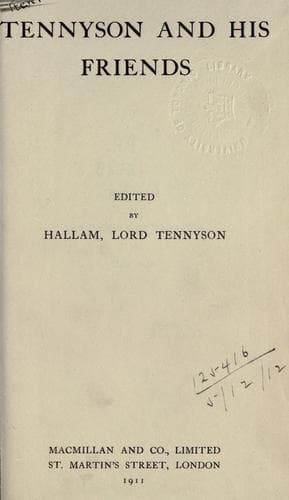
Tennyson, Alfred Tennyson, Baron, 1809-1892 -- Friends and associates
It was upon the rising wave after this calm that Tennyson was lifted
forward by the quick recognition of his talent among his ardent and
open-minded contemporaries; although his general popularity came
gradually, since even in 1850, as may be seen from the list already given
of his competitors for the Laureateship, his pre-eminence had not been
indisputably established in high political society. Yet all genuine judges
might perceive at once that here was the man to raise again from the lower
plane the imaginative power of verse, who knew the magical charm that
endows with beauty and dramatic force the incidents and impressions which
the ordinary artist can only reproduce in a commonplace or unreal way,
while the master-hand suddenly illumines the whole scene, foreground and
background. He struck a note that touched the feelings and satisfied the
spiritual needs of his contemporaries, and herein lay the promise of his
poetry; for to the departing generation the coming man can say little or
nothing. We have to bear in mind, also, that during Tennyson's youth the
whole complexion and "moving circumstance" of the age had undergone a
great alteration. It was the uproar and martial clang, the drums and
trampling of long and fierce wars, the mortal strife between revolutionary
and reactionary forces, that kindled the fiery indignation of Shelley and
Byron, inspiring such lines as
Still, Freedom, still thy banner, torn yet flying,
Streams like a meteor flag _against_ the wind,
and affected Coleridge and even Southey "in their hot youth, when George
the Third was king." Tennyson's opportunity came when these thunderous
echoes had died away, when the Reform Bill had become law, when the era of
general peace and comfortable prosperity that marks for England the middle
of this century was just setting in. The change may be noticed in
Tennyson's treatment of landscape, of the aspects of earth, sea, and sky.
With Byron and Coleridge the prevailing effects were grand, stormy, wildly
magnificent; with Tennyson the impressions are mainly peaceful,
melancholy, mysterious: he is looking on the happy autumn fields, or
listening in fancy to the long wash of Australasian seas. There are of
course exceptions on both sides; yet in Byron the best-known descriptive
passages are all of the former, and in Tennyson of the latter, character.
The difference in style corresponds, manifestly, not only with the
contrast in the temper of their times, warlike for the earlier poets and
peaceful for the later, but also with the disorder and unrest which vexed
the private lives of Byron, Shelley, and Coleridge, as compared with the
happy domestic fortunes of Tennyson.
Public-domain text, read in full here on John Shaqi.
Reviews
Reviews
No reviews yet
Be the first to share your thoughts on this work.
Elsewhere in the archive
Join the Discussion
Join the discussion
Sign in to leave a comment or review.
Sign InorCreate an account