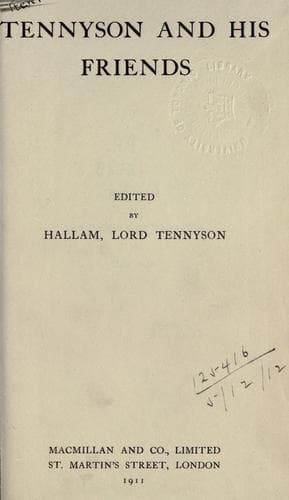
Tennyson, Alfred Tennyson, Baron, 1809-1892 -- Friends and associates
Tennyson's poetic career is in some respects unique in English literature.
He fell upon a time when fiction, science, and sociology were displacing
poetry. He succeeded in conquering the poetic indifference of his age. For
nearly sixty years he held a listening and eager audience, including not
only fastidious hearers but also the larger public. Probably no English
poet except Shakespeare has exercised such a commanding sway over both
learned and unlearned. He unsealed the eyes of his contemporaries and
revealed to them again the significance of beauty. To the English people,
and indeed the English-speaking race, he was not merely the gracious and
entrancing singer, but also the seer who divined their inmost thoughts
and interpreted them in melodious forms of verse.
At the outset of his poetic life, Arthur Hallam notes the "strange
earnestness of his worship of beauty." Like Milton, he was studious of
perfection. Like Milton, too, he had in a supreme degree the poet's double
endowment of an exquisite ear for the music of verse and an unerring eye
for the images of nature. Like Milton, he acquired a mastery of phrase
which has enriched the capacities of our English speech; and not Milton
himself drew from the purely English elements in the language more finely
modulated tones. No poet since Milton has been more deeply imbued with
classical literature, and the perfection of form which he sought fell at
once into a classic and mainly a Hellenic mould. We find in him
reminiscences or close reproductions not only of Homer and Theocritus, of
Virgil and Horace, of Lucretius and Catullus, of Ovid and Persius, but
also of Sappho and Alcman, of Pindar and Aeschylus, of Moschus,
Callimachus, and Quintus Smyrnaeus, more doubtfully of Simonides and
Sophocles. We can follow the tracks of his reading also in Herodotus,
Plato, Plutarch, and Livy. His early volumes contain varied strains of
classical and romantic legend. In some of the poems we are aware at once
of the pervasive atmosphere and enchantment of romance, as in "The Lady of
Shalott," "Mariana," "Sir Galahad," and many more. Others--such as
"Œnone," "The Lotos-Eaters," "Ulysses," "Tithonus"--what are we to call
them, classical or romantic? The thought and the form are chiefly
classical, but the poems are shot through with romantic gleams and tinged
with modern sentiment. Yet so skilful is the handling that there is no
sense of incongruity between the things of the past and the feelings of a
later day. The harmony of tone and colour is almost faultless, more so
than in the treatment of the longer themes taken from Celtic sources. But
while some poems are dominantly classical, others dominantly romantic,
Tennyson's genius as a whole is the spirit of romance expressing itself in
forms of classical perfection. To the romanticist he may seem classical;
to the classicist he is romantic: romantic in his choice of subjects, in
his attitude towards Nature, in his profusion of detail, in an ornateness
Public-domain text, read in full here on John Shaqi.
Reviews
Reviews
No reviews yet
Be the first to share your thoughts on this work.
Elsewhere in the archive
Join the Discussion
Join the discussion
Sign in to leave a comment or review.
Sign InorCreate an account