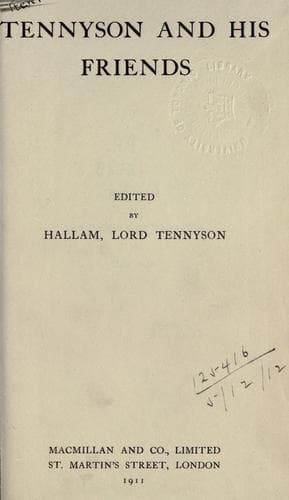
Tennyson, Alfred Tennyson, Baron, 1809-1892 -- Friends and associates
Throughout Tennyson's long career we can trace the essential oneness of
his mind and art, beginning with his early experiments in language and
metrical form. By degrees his range of subjects was enlarged; we are
amazed at the ever-growing variety of theme and treatment and his manifold
modes of utterance. In some, as in his lyrics and dramatic monologues, he
displays a flawless excellence, in almost all consummate art. But diverse
as are the chords he has struck, the voice, the touch, the melody are all
his own. In his latest poems we may miss something of the early rapture of
his lyric song, but he is still himself and unmistakable; and had he
written nothing but the lines "To Virgil" and "Crossing the Bar" he would
surely take rank among the highest. We think of him primarily as the
artist, but the artist and the man in him were never far apart; and as
years went on his human sympathies, always strong, were strengthened and
broadened, and drew him closer to the common life of humble people. We
overhear more of "the still sad music of humanity." Towards the close of
his life the moral and religious content of the poems becomes fuller with
his deepening sense of the grandeur and the pathos of man's existence.
Some see in this a weakening of his art, the intrusion into poetry of an
alien substance. Yet eliminate this element from art, and how much of the
greatest poetry of the world is gone! Now and then, it must be confessed,
the ethical aim in Tennyson seems to some of us unduly prominent, but
_very rarely_ does the artist lose himself in the teacher or the preacher.
He has a message to deliver, but it is not a mere moral lesson: its true
appeal is to the imagination; put it into prose and it is no longer his.
It lives only in its proper form of imaginative beauty.
Aristotle noted two types of poet, the [Greek: euphyês], the finely gifted
artist, plastic to the Muse's touch, who can assume many characters in
turn; and the [Greek: manikos], the inspired poet, with a strain of
frenzy, who is lifted out of himself in a divine transport. Were we asked
to select three examples of the former type, one from Greece, one from
Rome, and one from England, our choice from the ancient world would
probably fall on Sophocles and Virgil, and might we not, as a fitting
third, add Tennyson to the list? I do not attempt to determine their
relative rank, but I do suggest that they all belong to the same family,
and that already in this centenary year of our Poet we can recognize the
poetic kinship. Each of the three had in him the inmost heart of poetry,
beating with a full humanity and instinct with human tenderness; each
remained true to his calling as an artist and pursued throughout life the
vision of beauty; and each achieved, in his own individual way, a noble
and harmonious beauty of thought and form, of soul and sense.
JAMES SPEDDING
JAMES SPEDDING
By W. ALDIS WRIGHT, Vice-Master of Trinity College, Cambridge.
Public-domain text, read in full here on John Shaqi.
Reviews
Reviews
No reviews yet
Be the first to share your thoughts on this work.
Elsewhere in the archive
Join the Discussion
Join the discussion
Sign in to leave a comment or review.
Sign InorCreate an account