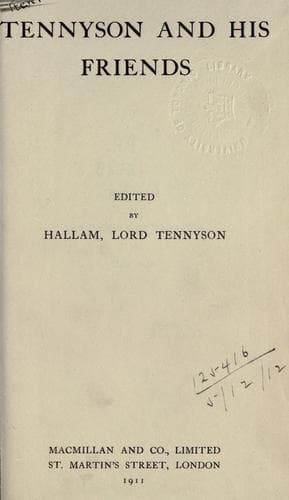
Tennyson, Alfred Tennyson, Baron, 1809-1892 -- Friends and associates
A new volume by A. T. is in preparation and will, I suppose, be out in
Autumn. In the meantime I have no copy of the "Palace of Art," but
shall be happy to repeat it to you when you come,--no copy of the
"Legend of Fair Women," but can repeat about a dozen stanzas which are
of the finest,--no copy of the conclusion of "Œnone" but one in
pencil which no one but myself can read. The two concluding stanzas of
"The Miller's Daughter," I can give you in this letter.... A broad
smiling letter from John Heath commissions me this morning to engage
Mrs. Perry's lodgings for Dunbar, whereat I rejoice: also informs me
that he himself keeps a Parroquet, and that Douglas has become a great
Berkeleian, and would leave his body, like Jeremy Bentham's, to be
dissected, if he thought he had one.
His brother Edward, who had been for some time in delicate health, died on
the 24th of August 1832, and a few days later Spedding writes to Thompson:
If you have seen Tennant you will be prepared to hear that my brother
Edward died early on Friday morning, after above a month of severe
suffering, leaving a ghastly vacancy in my prospects, not to be filled
up. However, what is past--the profit and the pleasure which I have
gathered out of long and pleasant years of brotherly society--this at
least is safe, and is so much to be thankful for. Why should I be the
sorrier because I have so long been graced with a source of comfort
and of pride, which, if I had never known, I should now be as cheerful
as when I last wrote to you? You knew him but little, but you knew him
enough to form some notion of how much I have to regret--or, in other
words, how much I have had to bless God for. He made a good and a
Christian end, and it is ascertained by a _post-mortem_ inspection
that he could not possibly have had health for any length of time
together. His disease was the formation of internal abscesses, in
consequence of a failure of some of the membranes, and quite beyond
the reach of surgery, so that, had one been at liberty to decide by a
wish whether he should live or die, it would have been an act of
unpardonable selfishness to wish him a moment more of captivity. This
too is something to take off the bitterness of regret, which, however,
in any way has no business to be bitter. But whether it is that I
value high human friendship more highly than I ought to do, or
whatever be the cause, a strange fatality seems to hang over the
objects of my more especial esteem, and I would have you, Thompson,
beware in time. But I shall lose my character with you if I do not
take care. I hope you will communicate the news to Tennant and Farish,
and to all our common friends, for explanations face to face are
formidable things.
Public-domain text, read in full here on John Shaqi.
Reviews
Reviews
No reviews yet
Be the first to share your thoughts on this work.
Elsewhere in the archive
Join the Discussion
Join the discussion
Sign in to leave a comment or review.
Sign InorCreate an account