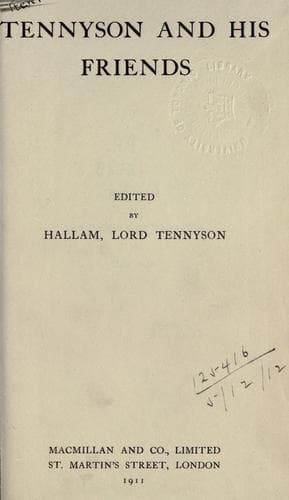
Tennyson, Alfred Tennyson, Baron, 1809-1892 -- Friends and associates
I have read your speech, not with the distant and respectful
admiration, the wonder broken off, which I am apt to call _faith_, but
with the deliberate admiration of a man who understands and strongly
assents. I see your audience had sense enough to utter loud cheers,
but I want to know whether they had sense enough to see that such a
speech ought not to be let pass away in a newspaper, but to be
provided with some permanent, portable, and self-subsisting existence.
If the proceedings of the day are to be published in a pamphlet, I
should like to invest money in a few copies. If not, I shall think
about printing your part of them in a legible shape on my own
account.... G. Farish is going to Madeira, with Sterling, I believe.
James F. speaks hopefully of the latter, but is more alarmed about his
brother.
In a letter to Allen we get a glimpse of Tennyson:
Alfred Tennyson has reappeared, and is going to-day or to-morrow to
Florence, or to Killarney, or to Madeira, or to some place where some
ship is going--he does not know where. He has been on a visit to a
madhouse for the last fortnight (not as a patient), and has been
delighted with the mad people, whom he reports the most agreeable and
the most reasonable persons he has met with. The keeper is Dr. Allen
(any relation of yours?), with whom he had been greatly taken!
Again writing to Thompson in October 1840 he says:
I have been studying Alfred Tennyson's MSS., and I send you a copy of
a poem which I think he once repeated to you and me, and which we
neither of us much entered into. Reading it again the other day, I was
surprised with the power and beauty of it, and I now think it wants
nothing but a better name, or, I should rather say, a historical
foundation. I would have it put into the mouth of some noted man
(among the many such that must have been) involved in a marriage which
he does not like, in violation of a pre-existing attachment. The
imagining of such situations for the mere purpose of entering into the
feelings which belong to them has something unwholesome in it, to my
fancy; but the situation being given (whether in fact or fiction),
there is no harm in turning it into poetry.
In 1840 Lord Lyndhurst was a candidate for the office of High Steward of
the University of Cambridge in opposition to Lord Lyttelton. Spedding
voted for the latter.
Public-domain text, read in full here on John Shaqi.
Reviews
Reviews
No reviews yet
Be the first to share your thoughts on this work.
Elsewhere in the archive
Join the Discussion
Join the discussion
Sign in to leave a comment or review.
Sign InorCreate an account