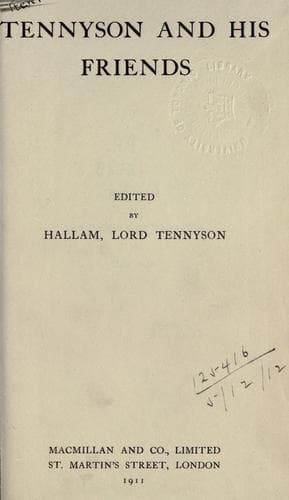
Tennyson, Alfred Tennyson, Baron, 1809-1892 -- Friends and associates
It may seem absurd in a man to print a book, and yet to wish not only
to keep it private, but also to prevent it from _circulating_
privately. But after considering the matter carefully, with reference
to what I may call the interest of the subject--I mean to the chance
of making a successful and durable impression upon the popular
opinion--I am satisfied that it would not be judicious to present the
question to the public _first_ in this form. It would probably provoke
controversy. The result of the controversy would depend upon
reviewers. Reviewers, until they have heard the evidence as well as
the argument, are not in a condition to judge; yet unless the evidence
be made easily accessible and bound up with the argument, they cannot
be expected either to seek it out or to suspend their opinions, but
will simply proceed to judgment _without_ hearing it. In such a case,
considering the strength of popular prepossessions and the tendency of
the first blow at them to raise a dust of popular objections, the
verdict would in the first instance go against me; and though I might
appeal with a better chance to the second thoughts and the next
generation, yet the appeal would be conducted at great disadvantage,
because I should then stand in the position of an advocate with a
personal interest in the cause. As it is, I hope in my division of
Bacon's works to set forth _all_ the evidence clearly and impartially,
so that everybody who has the book will have the means of judging for
himself, and if I can get that credit for justice and impartiality
which I mean to deserve, I do not much doubt the issue. But the first
reception of the work, upon which in these times so much depends, will
itself depend very much upon my coming before the public with a clear
and unsuspected character: and this, if I should previously acquire
the reputation (justly or not) of an advocate engaged to make good his
own cause, I could not expect.
FitzGerald, writing to Donne at the end of 1848, says of _Evenings with a
Reviewer_:
I saw many of my friends in London, Carlyle and Tennyson among them;
but most and best of all, Spedding. I have stolen his noble book away
from him; noble, in spite (I believe, but am not sure) of some
_adikology_ in the second volume: some special pleadings for his idol:
amica Veritas, sed magis, etc.
And Donne in reply:
I, too, have Spedding's "glorious book," which I prefer to any modern
reading. Reading one of his "Evenings" is next to spending an evening
with the author.
Thompson, whose health had completely broken down in 1849, was undergoing
the water-cure at Great Malvern, and early in 1850 Spedding writes to him:
Public-domain text, read in full here on John Shaqi.
Reviews
Reviews
No reviews yet
Be the first to share your thoughts on this work.
Elsewhere in the archive
Join the Discussion
Join the discussion
Sign in to leave a comment or review.
Sign InorCreate an account