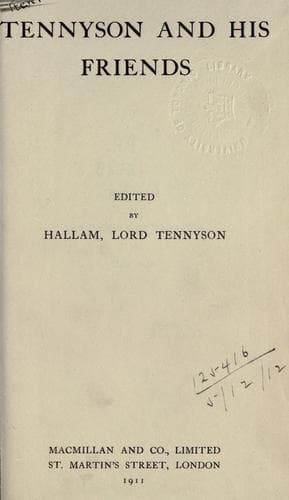
Tennyson, Alfred Tennyson, Baron, 1809-1892 -- Friends and associates
The paradox is that it was FitzGerald who was always urging "Alfred" to go
on, and finding fault with him for not doing more, and not singing in
grander, sterner strains,--not becoming the Tyrtaeus of his country. In
truth, Tennyson's strength and physical force and his splendid appearance
in youth, added to his mental grandeur, seem to have deeply impressed his
youthful contemporaries. He was, they felt, heroic, and made for heroic
songs and deeds. When he did go on, in his own way, FitzGerald did not
like it, or only half liked it. For Tennyson did go forward on his own
lines. He had not a little to daunt and deter him. He, too, had his
sensitiveness and capacity for feeling and passion not less exquisite than
FitzGerald's own. FitzGerald said his friendships were more like loves. He
was not alone in this attitude. "What _passions_ our friendships were,"
wrote Thackeray, another of the set, the early friend of both FitzGerald
and Tennyson. But of no friendship could such language be used more truly
than of that which existed between Tennyson and Arthur Hallam. When,
however, the sundering blow fell, and the friendship which was a love lay
shattered, Tennyson braced himself and went on. For
It becomes no man to nurse despair,
But in the teeth of clench'd antagonisms
To follow up the worthiest till he die.
His faith, even to the last, was still at times dashed with doubt, for,
with "the universality of his mind," he could not help seeing many sides
of a question. But he "followed the Gleam," as he has himself described.
FitzGerald did the opposite. He drifted, he dallied, he delayed, he
despaired. He ruined his own life in great measure by his marriage. His
early ambitions seemed to wither prematurely, and he let his career slide.
Yet he was always, as Mr. A. C. Benson has excellently brought out,
admirable in his sincerity, his friendly kindliness, his innocence, his
conscientious adherence to his literary standards. Too much has been made
of his unconventionality, his slovenliness and slackness, his love of low
or common company. He remained a gentleman and a man of business.
Thackeray, a man of the world, when he was starting for America, wanted to
leave him the legal guardian of his daughters. He was an Epicurean, not a
Pyrrhonist. He took life seriously. He showed at times an austerity of
spirit which was surprising. His _Omar_ has often, and naturally, been
compared to Lucretius and to Ecclesiastes. There is probably more of
Lucretius about the poem, but more of Ecclesiastes about the translator.
Public-domain text, read in full here on John Shaqi.
Reviews
Reviews
No reviews yet
Be the first to share your thoughts on this work.
Elsewhere in the archive
Join the Discussion
Join the discussion
Sign in to leave a comment or review.
Sign InorCreate an account