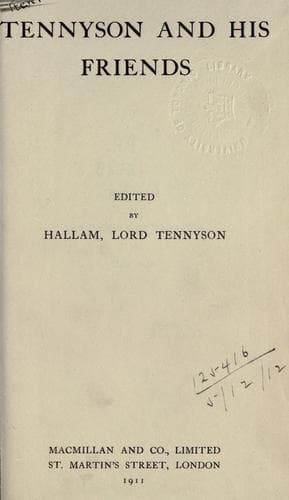
Tennyson, Alfred Tennyson, Baron, 1809-1892 -- Friends and associates
Toward the end of his life, Carlyle, in the Inaugural Address given by him
as Rector of Edinburgh University, in which he summed up so many of the
convictions of a lifetime, put forward the following description of the
completely healthy human spirit. "A man all lucid and in equilibrium. His
intellect a clear mirror, geometrically plane, brilliantly sensitive to
all objects and impressions made on it, and imaging all things in their
correct proportions, not twisted up into convex or concave and distorting
everything so that he cannot see the truth of the matter without endless
groping and manipulation--healthy, clear and free, and discerning all
round about him." He put this picture before young men as the ideal to be
aimed at by the intellectual student, and in particular by the man of
letters. "But," he said, "we can never never attain that at all." Perhaps
not altogether. Perhaps even he who invented the phrase for the poet's
duty of "holding the mirror up to Nature," did not wholly attain to it.
But, according to his measure, it is no bad description of Alfred
Tennyson, with the "universality of his mind," the simplicity of his good
sense, the childlike sincerity of his spirit. This quality it was that
both Carlyle and FitzGerald found and liked in him.
It has been said that Tennyson and FitzGerald read the same books. One of
the best instances of this is to be found in a long letter of FitzGerald's
about posthumous fame and literary immortality. It was written to Cowell
in 1847, and is given by Dr. Aldis Wright in his first collection. After
speaking of Homer and the _Iliad_, FitzGerald writes:
Yet as I often think it is not the poetical imagination, but bare
Science that every day more and more unrolls a greater Epic than the
Iliad; the history of the world, the great infinitudes of Space and
Time! I never take up a book of Geology or Astronomy but this strikes
me. And when we think that Man must go on in the same plodding way,
one fancies that the Poet of to-day may as well fold his hands, or
turn them to dig and delve, considering how soon the march of
discovery will distance all his imaginations and dissolve the language
in which they are uttered. Martial, as you say, lives now after two
thousand years: a space that seems long to us whose lives are so
brief; but a moment, the twinkling of an eye, if compared (not to
Eternity alone), but to the ages which it is now known the world must
have existed, and (unless for some external violence) must continue to
exist.
Public-domain text, read in full here on John Shaqi.
Reviews
Reviews
No reviews yet
Be the first to share your thoughts on this work.
Elsewhere in the archive
Join the Discussion
Join the discussion
Sign in to leave a comment or review.
Sign InorCreate an account