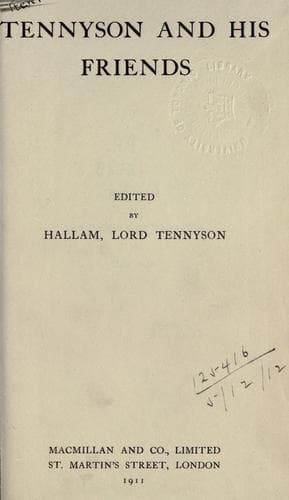
Tennyson, Alfred Tennyson, Baron, 1809-1892 -- Friends and associates
What be those two shapes high over the sacred fountain,
Taller than all the Muses, and huger than all the mountain?
On those two known peaks they stand, ever spreading and heightening;
Poet, that evergreen laurel is blasted by more than lightning!
Look, in their deep double shadow the crown'd ones all disappearing!
Sing like a bird and be happy, nor hope for a deathless hearing!
Sounding for ever and ever? pass on! the sight confuses--
These are Astronomy and Geology, terrible Muses!
So far Tennyson agrees with _Omar_:
Ah make the most of what we yet may spend
Before we too into the dust descend;
Dust into dust and under dust to lie,
Sans wine, sans song, sans singer and sans end!
But then comes the divergence, conveyed with the exquisitely sympathetic
change of rhythm:
If the lips were touch'd with fire from off a pure Pierian altar,
Tho' their music here be mortal, need the singer greatly care?
Other songs for other worlds! the fire within him would not falter;
Let the golden Iliad vanish, Homer here is Homer there.
The beautiful lines which form the Envoy to "Tiresias," already alluded
to, never reached their address. I remember well, when we spoke of
FitzGerald, the sadness with which Tennyson said to me, "He never saw
them. He died before they were sent him." After his death Tennyson added
the Epilogue on the same note. It is touching to see that in his closing
lines to his old friend he had hinted with tender delicacy at the same
creed to which he always clung:
Gone into darkness, that full light
Of friendship! past, in sleep, away
By night, into the deeper night!
The deeper night? A clearer day
Than our poor twilight dawn on earth--
If night, what barren toil to be!
What life, so maim'd by night, were worth
Our living out? Not mine to me
Remembering all the golden hours
Now silent, and so many dead
And him the last; and laying flowers,
This wreath, above his honour'd head,
And praying that, when I from hence
Shall fade with him into the unknown,
My close of earth's experience
May prove as peaceful as his own.
Like many rough and overbearing men Carlyle liked those who stood up to
him and gave him back, in his own phrase, "shake for shake." FitzGerald
was one of these. He made his better acquaintance by contradicting and
correcting him about the battlefield and the buried warriors of Naseby
Fight. Carlyle took it all in excellent part, and they became close
friends. Carlyle went to visit him and invited the many letters which
FitzGerald wrote. In his later years he sent one of these letters to C. E.
Norton as a "slight emblem and memorial of the peaceable, affectionate,
ultra-modest man and his innocent _far niente_ life"; "and," he adds, "the
connection (were there nothing more) of Omar, the Mahometan Blackguard,
and Oliver Cromwell, the English Puritan."
Public-domain text, read in full here on John Shaqi.
Reviews
Reviews
No reviews yet
Be the first to share your thoughts on this work.
Elsewhere in the archive
Join the Discussion
Join the discussion
Sign in to leave a comment or review.
Sign InorCreate an account