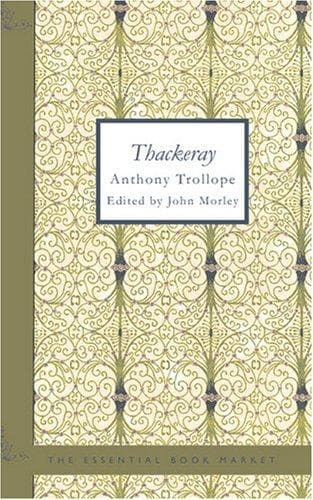
Novelists, English -- 19th century -- Biography; Thackeray, William Makepeace, 1811-1863
And yet in very truth the realistic must not be true,--but just so far
removed from truth as to suit the erroneous idea of truth which the
reader may be supposed to entertain. For were a novelist to narrate a
conversation between two persons of fair but not high education, and to
use the ill-arranged words and fragments of speech which are really
common in such conversations, he would seem to have sunk to the
ludicrous, and to be attributing to the interlocutors a mode of language
much beneath them. Though in fact true, it would seem to be far from
natural. But on the other hand, were he to put words grammatically
correct into the mouths of his personages, and to round off and to
complete the spoken sentences, the ordinary reader would instantly feel
such a style to be stilted and unreal. This reader would not analyse it,
but would in some dim but sufficiently critical manner be aware that his
author was not providing him with a naturally spoken dialogue. To
produce the desired effect the narrator must go between the two. He must
mount somewhat above the ordinary conversational powers of such persons
as are to be represented,--lest he disgust. But he must by no means soar
into correct phraseology,--lest he offend. The realistic,--by which we
mean that which shall seem to be real,--lies between the two, and in
reaching it the writer has not only to keep his proper distance on both
sides, but has to maintain varying distances in accordance with the
position, mode of life, and education of the speakers. Lady Castlewood
in _Esmond_ would not have been properly made to speak with absolute
precision; but she goes nearer to the mark than her more ignorant lord,
the viscount; less near, however, than her better-educated kinsman,
Henry Esmond. He, however, is not made to speak altogether by the card,
or he would be unnatural. Nor would each of them speak always in the
same strain, but they would alter their language according to their
companion,--according even to the hour of the day. All this the reader
unconsciously perceives, and will not think the language to be natural
unless the proper variations be there.
In simple narrative the rule is the same as in dialogue, though it does
not admit of the same palpable deviation from correct construction. The
story of any incident, to be realistic, will admit neither of
sesquipedalian grandeur nor of grotesque images. The one gives an idea
of romance and the other of burlesque, to neither of which is truth
supposed to appertain. We desire to soar frequently, and then we try
romance. We desire to recreate ourselves with the easy and droll. Dulce
est desipere in loco. Then we have recourse to burlesque. But in neither
do we expect human nature.
Public-domain text, read in full here on John Shaqi.
Reviews
Reviews
No reviews yet
Be the first to share your thoughts on this work.
Elsewhere in the archive
Join the Discussion
Join the discussion
Sign in to leave a comment or review.
Sign InorCreate an account