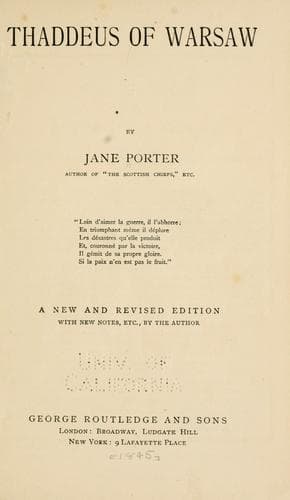
Poland -- History -- Stanislaus II Augustus, 1764-1795 -- Fiction
He had not walked much further before the piercing cold of the
evening, and a shower of snow, which began to fall, made him feel the
effects of his loss; however, that did not annoy him; he had been too
heavily assailed by the pitiless rigors of misfortune to regard the
pelting of the elements. Whilst the wind blew in his face, and the
sleet falling on his dress, lodged in its lappels, he went forward,
calculating whether it were likely that this money, with the few
shillings he yet possessed, would be sufficient to discharge what he
owed. Unused as he had been to all kinds of expenditure which
required attention, he supposed, from what he had already seen of a
commerce with the world, that the sum he had received from the Jew
was not above half what he needed; and with a beating heart he walked
towards one of those shops which Mrs. Robson had described, when
speaking of the irregularities of her son, who had nearly reduced her
to beggary.
The candles were lit. And as he hovered about the door, he distinctly
saw the master through the glass, assorting some parcels on the
counter. He was a gentleman-like man, and the count's feelings took
quite a different turn from those with which he had accosted the Jew,
who, being a low, sordid wretch, looked upon the people with whom he
trafficked as mere purveyors to his profit. Thaddeus felt little
repugnance at bargaining with him: but the sight of a respectable
person, before whom he was to present himself as a man in poverty, as
one who, in a manner, appealed to charity, all at once overcame the
resolution of a son of Sobieski, and he debated whether or not he
should return. Mrs. Robson, and her probable distresses, rose before
him; and fearful of trusting his pride any further, he pulled his cap
over his face, and entered the shop.
The man bowed very civilly on his entrance, and requested to be
honored with his commands. Thaddeus felt his face glow; but indignant
at his own weakness, he laid the gold case on the counter, and said,
in a voice which, notwithstanding his emotion, he constrained to be
without appearance of confusion, "I want to part with this."
Astonished at the dignity of the applicant's air, and the nobility of
his dress, (for the star did not escape the shop-keeper's eye), he
looked at him for a moment, holding the case in his hand. Hurt by the
steadiness of his gaze, the count, rather haughtily, repeated what he
had said. The man hesitated no longer. He had been accustomed to
similar requests from the emigrant French _noblesse_; but there
was a loftiness and aspect of authority in the countenance and mien
of this person which surprised and awed him; and with a respect which
even the application could not counteract, he opened the case, and
inquired of Thaddeus what was the price he affixed to it.
"I leave that to you," replied he.
Public-domain text, read in full here on John Shaqi.
Reviews
Reviews
No reviews yet
Be the first to share your thoughts on this work.
Elsewhere in the archive
Join the Discussion
Join the discussion
Sign in to leave a comment or review.
Sign InorCreate an account