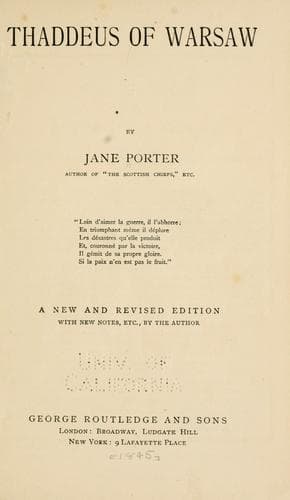
Poland -- History -- Stanislaus II Augustus, 1764-1795 -- Fiction
"About two months after Mr. Stanhope's departure, a letter arrived
from him, urging me to fly with him to Scotland. He alleged as a
reason for such a step that his grandfather, the Earl of Tinemouth,
insisted on his forming a union with Lady Olivia Lovel, who was then
a young widow, and the favorite niece of the most powerful nobleman
in the kingdom. Upon this demand, he confessed to the earl that his
affections were engaged. His lordship, whose passions were those of a
madman, broke into such horrible execrations of myself and my family,
that Mr. Stanhope, himself, alas! enraged, intemperately swore that
no power on earth should compel him to marry so notorious a woman as
Lady Olivia Lovel, nor to give me up. After communicating these
particulars, he concluded with repeating his entreaties that I would
consent to marry him in Scotland. The whole of this letter so alarmed
me, that I showed it to my parents. My father answered it in a manner
befitting his own character; but that only irritated the impetuous
passions of my lover. In the paroxysm of his rage, he flew to the
earl his grandfather, upbraided him with the ruin of his happiness,
and so exasperated the old man, that he drew his sword upon him; and
had it not been for the interference of his father, Lord Harwold, who
happened to enter at the moment, a most fatal catastrophe might have
ensued. To end the affair at once, the latter, whose gentle nature
embraced the mildest measures, obtained the earl's permission to send
Mr. Stanhope abroad.
"Meanwhile I was upheld by my revered parent, who is now no more, in
firmly rejecting my lover's entreaties for a private marriage. And as
his grandfather continued resolutely deaf to his prayers or threats,
he was at length persuaded by his excellent father to accompany some
friends to France.
"At the end of a few weeks Mr. Stanhope began to regard them as spies
on him; and after a violent quarrel, they parted, no one knowing to
what quarter my lover directed his steps. I believe I was the first
who heard any tidings of him. I remember well; it was in 1773, about
four-and-twenty years ago, that I received a letter from him. Oh! how
legibly are these circumstances written on my memory! It was dated
from Italy, where, he told me, he resided in complete retirement,
under the assumed name of Sackville."
At this name, with every feature fixed in dismay, Thaddeus fell back
on the sofa.
The countess caught his hand.
"What is the matter? You are ill? What is the matter?"
The bolt of indelible disgrace had struck to his heart. It was some
minutes before he could recover; but when he did speak, he said,
"Pray go on, madam; I am subject to this. Pray forgive me, and go on;
I shall become better as you proceed."
"No, my dear friend; I will quit my dismal story at present, and
resume it some other time."
"Pray continue it now," rejoined Thaddeus; "I shall never be more fit
to listen. Do, I entreat you."
Public-domain text, read in full here on John Shaqi.
Reviews
Reviews
No reviews yet
Be the first to share your thoughts on this work.
Elsewhere in the archive
Join the Discussion
Join the discussion
Sign in to leave a comment or review.
Sign InorCreate an account