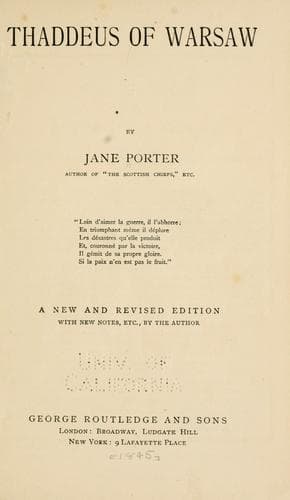
Poland -- History -- Stanislaus II Augustus, 1764-1795 -- Fiction
"I looked in the newspaper this morning," said Miss Beaufort, "and I
think it is called _Sighs_,--a translation from a drama of
Kotzebue's."
"A strange title!" was the general observation. When Mr. Suett, who
personated one of the characters, began to speak, their attention was
summoned to the stage.
On the entrance of Mr. Charles Kemble in the character of Adelbert,
the count unconsciously turned pale. He perceived by the dress of the
actor that he was to personate a Pole; and alarmed at the probability
of seeing something to recall recollections which he had striven to
banish, his agitation did not allow him to hear anything that was
said for some minutes.
Miss Egerton was not so tardy in the use of her eyes and ears; and
stretching out her hand to the back of the box, where Thaddeus was
standing by Lady Sara's chair, she caught hold of his sleeve.
"There, Mr. Constantine!" cried she; "look at Adelbert! that is
exactly the figure you cut in your outlandish gear two months ago."
Thaddeus bowed with a forced smile, and glancing at the stage,
replied--
"Then, for the first time in my life, I regret having followed a
lady's advice; I think I must have lost by the change."
"Yes," rejoined she, "you have lost much fur and much embroidery, but
you now look much more like a Christian.'"
The substance of these speeches was not lost on Mary, who continued
with redoubling interest to mark the changes his countenance
underwent along with the scene. As she sat forward, by a slight turn
of the head she could discern the smallest fluctuation in his
features, and they were not a few. Placing himself at the back of
Lady Sara's chair, he leaned over, with his soul set in his eye,
watching every motion of Mr. Charles Kemble.
Mary knew, by some accidental words from Lady Tinemouth, that
Constantine was a Polander, and the surmise she had entertained of
his being unfortunate received full corroboration at the scene in
which Adelbert is grossly insulted by the rich merchant. During the
whole of it, she scarcely dared trust her eyes towards Constantine's
flushed and agitated face.
The interview between Adelbert and Leopold commenced. When the former
was describing his country's miseries with his own, Thaddeus unable
to bear it longer, unobserved by any but Mary, drew back into the
box. In a moment or two afterwards Mr. Charles Kemble made the
following reply to an observation of Leopold's, that "poverty is no
dishonor."
"Certainly none to me! To Poland, to my struggling country, I
sacrificed my wealth, as I would have sacrificed my life if she had
required it. My country is no more; and we are wanderers on a
burdened earth, finding no refuge but in the hearts of the humane and
virtuous."
Public-domain text, read in full here on John Shaqi.
Reviews
Reviews
No reviews yet
Be the first to share your thoughts on this work.
Elsewhere in the archive
Join the Discussion
Join the discussion
Sign in to leave a comment or review.
Sign InorCreate an account