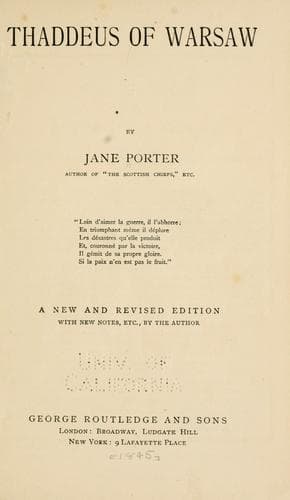
Poland -- History -- Stanislaus II Augustus, 1764-1795 -- Fiction
There was something in the tones of Lady Sara's voice and in her
manner far more expressive than her words: mutual sighs which
breathed from her ladyship's bosom and that of Thaddeus, as they sat
down, made a cold shiver run from the head to the foot of Miss
Beaufort. Mary's surprise at the meaning of this emotion caused a
second tremor, and with a palpitating heart she asked herself a few
questions.
Could this interesting young man, whom every person of sense appeared
to esteem and respect, sully his virtues by participating in a
passion with a married woman? No; it was impossible.
Notwithstanding this decision, so absolute in his exculpation, her
pure heart felt a trembling, secret resolve, "even for the sake of
the honor of human nature," (she whispered to herself), to observe
him so hereafter as to be convinced of the real worth of his
principles before she would allow any increase of the interest his
apparently reversed fate had created in her compassionate bosom.
What might be altogether the extent of that "reversed fate," she
could form no idea. For though she had heard, in common with the rest
of the general society, of the recent "melancholy fate of Poland!"
she knew little of its particulars, politics of every kind, and
especially about foreign places, being an interdicted subject in the
drawing-rooms of Sir Robert Somerset. Therefore the simply noble mind
of Mary thought more of the real nobility that might dwell in the
soul of this expatriated son of that country than of the possible
appendages of rank he might have left there.
With her mind full of these reflections, she awaited the farce
without observing it when it appeared. Indeed, none of the party knew
anything about the piece (to see which they had professedly come to
the theatre) excepting Miss Egerton, whose ever merry spirits had
enjoyed alone the humor of Totum in the play, and who now laughed
heartily, though unaccompanied, through the ridiculous whims of the
farce.
Nothing that passed could totally disengage the mind of Thaddeus from
those remembrances which the recent drama had aroused. When the
melting voice of Lady Sara, in whispers, tried to recall his
attention, by a start only did he evince his recollection of not
being alone. Sensible, however, to the kindness of her motive, he
exerted himself; and by the time the curtain dropped, he had so far
rallied his presence of mind as to be able to attend to the civility
of seeing the ladies safe out of the theatre.
Miss Egerton, laughing, as he assisted her into the carriage, said,
"I verily believe, Mr. Constantine, had I glanced round during the
play, I should have seen as pretty a lachrymal scene between you and
Lady Sara as any on the stage. I won't have this flirting! I declare
I will tell Captain Ross--"
She continued talking; but turning about to offer his service to Miss
Beaufort, he heard no more.
Public-domain text, read in full here on John Shaqi.
Reviews
Reviews
No reviews yet
Be the first to share your thoughts on this work.
Elsewhere in the archive
Join the Discussion
Join the discussion
Sign in to leave a comment or review.
Sign InorCreate an account