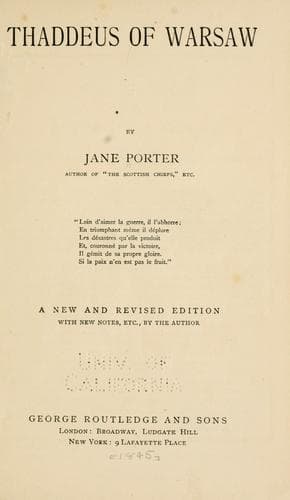
Poland -- History -- Stanislaus II Augustus, 1764-1795 -- Fiction
Euphemia's affected attachment suggested to Thaddeus a few unpleasant
recollections respecting the fervent and unequivocal passion of Lady
Sara. Though guilty, it sprung from a headlong ardor of disposition
which formed at once the error and its palliation. He saw that love
was not welcomed by her (at least he thought so) as a plaything, but
struggled against as with a foe. He had witnessed her tortures; he
pitied them, and to render her happy, would gladly have made any
sacrifice short of his conscience. Too well assured of being all the
world to Lady Sara, the belief that Miss Euphemia liked him only from
idleness, caprice, and contradiction, caused him to repay her
overtures with decided contempt.
When he arrived at home, he threw on his table the pocket-book whose
unambiguous motto made him scorn her, and almost himself for being
the object of such folly. Looking round his humble room, whose
wicker-chairs, oil-cloth floor, and uncurtained windows announced
anything but elegance: "Poor Euphemia!" said he; "how would you be
dismayed were the indigent Constantine to really take you at your
word, and bring you home to a habitation like this!"
* * * * * * *
CHAPTER XXX.
INFLUENCES OF CHARACTER.
The recital of the preceding scene, which was communicated to Miss
Beaufort by Euphemia, filled her with still more doubting thoughts.
Mary could discover no reason why the old gentleman's mental
derangement should dignify his friend with titles he had never borne.
She remarked to herself that his answer to Euphemia was evasive; she
remembered his emotion and apology on seeing Mr. C. Kemble in
Adelbert; and uniting with these facts his manners and acquirements,
so far beyond the charges of any subordinate rank, she could finally
retain no doubt of his being at least well born.
Thus this mysterious Constantine continued to occupy her hourly
thoughts during the space of two months, in which time she had full
opportunity to learn much of a character with whom she associated
almost every day. At Lady Tinemouth's (one of whose evening guests
she frequently became) she beheld him disencumbered of that armor of
reserve which he usually wore in Harley Street.
In the circle of the countess, Mary saw him welcomed like an idolized
being before whose cheering influence all frowns and clouds must
disappear. When he entered, the smile resumed its seat on the languid
features of Lady Tinemouth; Miss Egerton's eye lighted up to keener
archness; Lady Sara's Circassian orbs floated in pleasure; and for
Mary herself, her breast heaved, her cheeks glowed, her hands
trembled, a quick sigh fluttered in her bosom; and whilst she
remained in his presence, she believed that happiness had lost its
usual evanescent property, and become tangible, to hold and press
upon her heart.
Public-domain text, read in full here on John Shaqi.
Reviews
Reviews
No reviews yet
Be the first to share your thoughts on this work.
Elsewhere in the archive
Join the Discussion
Join the discussion
Sign in to leave a comment or review.
Sign InorCreate an account