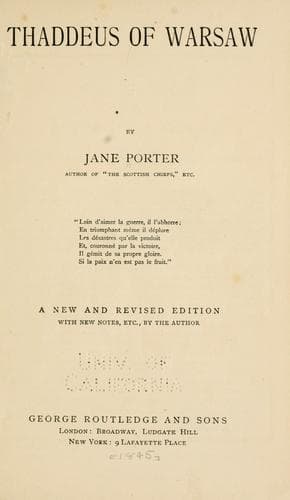
Poland -- History -- Stanislaus II Augustus, 1764-1795 -- Fiction
Whilst his necessities reproached them for this illiberal conduct,
his proud heart recoiled at making a request to their chanty; for he
had gathered from the haughty demeanor of Miss Diana that what he was
entitled to demand would be given, not as a just remuneration for
labor received, but as alms of humanity to an indigent emigrant.
"I would rather perish," cried he, putting on his hat, "than ask that
woman for a shilling."
When the count laid his treasure on the table of the worthy
pawnbroker, he desired to have the value of the settings of the
pictures, and the portraits themselves put into leather cases. With
the other little things, there were a pair of gold spurs, the
peculiar insignia of his princely rank, which the palatine himself
had buckled on his grandson's heels on mounting his noble charger for
his first field. There was a peculiar pang in parting with these--a
sort of last relic of what he had been! But there was no alternative:
all that had any intrinsic value must pass from him.
Having examined the setting of the miniatures, and the gold of the
other trinkets, with that of the spurs (which their hard service had
something marred), Mr. Burket declared, on the word of an honest man,
that he could not give more than fifteen pounds.
With difficulty Thaddeus stifled as torturing a sigh as ever
distended his breast, whilst he said,
"I will take it, I only implore you to be careful of the things,
trifling as they are; circumstances with which they were connected
render them valuable to me to redeem."
"You may depend on me, sir," replied the pawnbroker, presenting him
the notes and acknowledgment.
When Thaddeus took them, Mr. Burket's eye was caught by the ring on
his finger.
"That ring seems curious? If you won't think me impertinent, may I
ask to look at it?"
The count pulled it off, and forcing a smile, replied, "I suppose it
is of little jewel value. The setting is slight, though the painting
is fine."
Burket breathed on the diamonds. "If you were to sell it," returned
he, "I don't think it would fetch more than three guineas. The
diamonds are flawed, and the emeralds would be of little use, being
out of fashion here; as for the miniature, it goes for nothing."
"Of course," said Thaddeus, putting it on again; "but I shall not
part with it." While he drew on his glove, Mr. Burket asked him
"whether the head were not intended for the King of Poland?"
The count, surprised, answered in the affirmative.
"I thought so," answered the man; "it is very like two or three
prints which I had in my shop of that king. [Footnote: The author
has a very correct likeness of this memorable king, copied from an
original miniature; and it is not one of the least valued portraits
in a little room which contains those of several other heroes of
different countries,--friends and gallant foes.] Indeed, I believe I
have them somewhere now: these matters are but a nine-day's wonder,
and the sale is over."
Public-domain text, read in full here on John Shaqi.
Reviews
Reviews
No reviews yet
Be the first to share your thoughts on this work.
Elsewhere in the archive
Join the Discussion
Join the discussion
Sign in to leave a comment or review.
Sign InorCreate an account