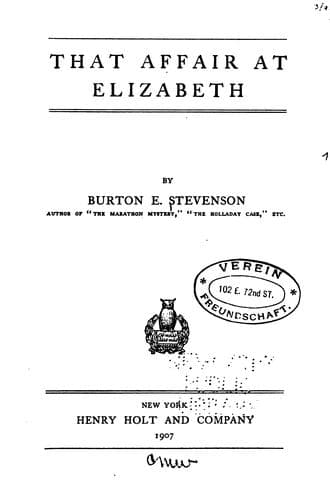
Detective and mystery stories; Fiction; Love stories
So he had made inquiries at the asylum, had learned her address, and had
taken the train for Elizabeth on the morning of that fatal tenth of
June. He had made his way to the Kingdon cottage, had found Harriet
Kingdon there alone, had entered, seated himself familiarly, perhaps
attempted some endearment. He was confident, self-satisfied. It was
better than he had hoped. Here was a comfortable home ready for him; a
wife who seemed to be making a good living. If it should be necessary,
he could no doubt find many pupils at Elizabeth, and if the pay was not
quite metropolitan, why, neither was the work. Here was a golden future;
yes, he would be generous; she should be his wife; he would forget all
that had happened....
But the sight of him had brought back the memory of her old infamy,
which her attack of madness and the years had partially blotted out; the
cloud rolled down upon her brain again, that white hate leaped to life.
She snatched up her revolver and shot him through the heart, even as he
sat there confidently smiling. Then, with a strength born of insanity,
she had dragged him to the cellar and dug a grave for him there.
The story was strong in every link; there could be no doubting it.
* * * * *
Not until the inquest was finished, and we entered the train together to
return to New York, did I get the chance to talk quietly with Godfrey.
"You did great work," I said, as we sat down together.
"Yes," he agreed, smiling, "I was pleased with it myself. The story
developed beautifully."
"And clearly. Even the coroner's jury couldn't question it. There's no
possibility, now, of any one associating this affair with Miss
Lawrence's disappearance. If it had to happen, I'm glad that it happened
just when it did--it's served to make the public forget the other
mystery. I'm pleased for another reason," I added. "Lucy Kingdon won't
be called upon to tell that story on the stand. I don't like her nor
trust her, but I'm glad she'll be spared that ordeal."
"It would have been a trying one," Godfrey agreed. "The coroner tells me
that she's very ill. I feel guilty, in a way. I should have prepared her
for that horror in the cellar. I shouldn't have taken her without
warning to the brink of that grave."
"That wasn't the only cause of her illness," I said. "She had sins of
her own on her conscience. I don't understand even yet," I added, "why
that face should affect her so. She couldn't have recognised it, since
she'd never seen Parello."
"How do you know she never saw him? I'm decidedly inclined to think she
had--that he was the cause of that violent quarrel between her and her
sister which Dr. Schuyler mentioned. Lucy Kingdon, looking at the man
clear-eyed, saw him as he was and tried to dissuade her sister from the
entanglement; the elder woman, blinded by passion, wouldn't listen, and
the quarrel followed, in which both, no doubt, used words which they
afterwards regretted."
Public-domain text, read in full here on John Shaqi.
Reviews
Reviews
No reviews yet
Be the first to share your thoughts on this work.
Elsewhere in the archive
Join the Discussion
Join the discussion
Sign in to leave a comment or review.
Sign InorCreate an account