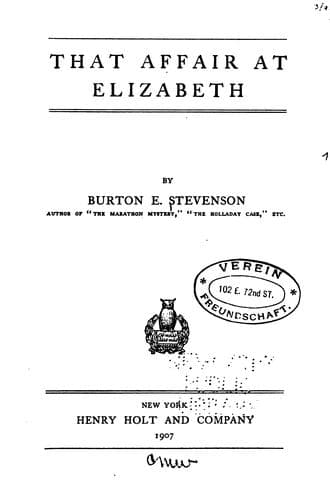
Detective and mystery stories; Fiction; Love stories
"Moonshine! I should say so! Now, Lester, I want you to stay there till
you get this thing straightened out, if only for Curtiss's sake. I know
you can prove that any such theory as that is all bosh."
"I'll try to," I answered him, and hung up the receiver; but I confess
that I was not at all sure of my ability to accomplish the task.
As I left the booth, the clerk came toward me.
"There's a gentleman inquiring for you, Mr. Lester," he said. "He was
here about noon asking for you, but wouldn't have you disturbed. He's
over here in the parlour, waiting for you."
I followed him to the door of the parlour.
"This is Mr. Lester," he said to a white-haired old man who was pacing
nervously up and down, and left us alone together.
For a moment I did not recognise him, then as he came forward into the
clearer light, I found myself looking down into the face of Dr.
Schuyler.
"My dear Mr. Lester," he said, advancing with outstretched hand, "I hope
you will pardon this intrusion."
"It's not in the least an intrusion," I said, honestly glad to see him.
"Thank you. Let us sit down over here by the window, if you will. I do
not wish to run any risk of being overheard," and he glanced about
anxiously.
As I looked at him more closely, I saw that he was labouring under some
deep trouble or anxiety. His face was pale and haggard, and he fingered
his glasses with a nervousness which I knew was not habitual.
"The truth of the matter is," he went on, "that I feel the need of
advice--legal advice. I have friends here, of course, to whom I could
have gone; but I was told that you were interested in this case, and
from what I saw of you the other evening, I felt that I should like to
lay my difficulty before you. It is, as I said, a purely legal question,
or I should not have felt the need of any earthly counsel."
I thanked him for his confidence and begged him to continue.
"As I understand the law," he went on, "an insane person cannot be
punished for a crime."
"No," I said, "except by being confined in an asylum until cured--and
even that is largely discretionary."
"And what, in law, is considered insanity--what is the test for it?"
"Inability to distinguish right from wrong is the usual test. No man is
excused from responsibility for a crime, if he has the capacity and
reason sufficient to enable him to distinguish between right and wrong,
as to the particular act he is then doing."
I fancied I heard the clergyman breathe a sigh of relief.
"A person, then, may be sane as regards some things, and insane as
regards others?"
"Undoubtedly."
"Would the fact that a person had at one time been confined in an
asylum, and had occasional lapses from sanity afterward, tend to prove
that he was insane at the time of committing a crime?"
"It would tend to prove it very strongly; especially if the
circumstances under which the crime was committed were related in any
way to the cause of the insanity."
He paused a moment in deep thought.
Public-domain text, read in full here on John Shaqi.
Reviews
Reviews
No reviews yet
Be the first to share your thoughts on this work.
Elsewhere in the archive
Join the Discussion
Join the discussion
Sign in to leave a comment or review.
Sign InorCreate an account