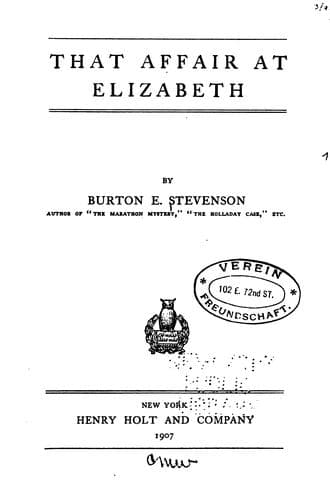
Detective and mystery stories; Fiction; Love stories
"Oh, yes; it was from her I learned the story. She came to me for advice
a few months after Harriet Kingdon had been brought home. I don't think
she was ever wholly cured. She had slight relapses from time to time,
and it was during one of these, rather more violent than usual, that
Mrs. Lawrence came to me. I made an excuse for going to see her. But I
saw no reason for advising that she be sent to an asylum. I did advise,
however, that a specialist be brought down from New York to look at her,
and Mrs. Lawrence did this. He also advised against the asylum; he said
that rest, and quiet, and freedom from worry would, in time, afford
permanent relief. She certainly grew better as time went on, and, though
she was always somewhat peculiar, I have regarded her as wholly out of
danger of relapse, for several years past."
"And yet," I objected, harking back, "heredity of itself would hardly be
sufficient explanation. There must have been something to induce
insanity--some shock or grave trouble."
"Yes, I agree with you there. I have a theory, Mr. Lester, which some
chance words of yours this afternoon served greatly to strengthen. You
remember, you remarked that a recurrence of insanity would be very
likely if the circumstances attending it were related in any way to the
original cause. My theory is that this man whom Harriet Kingdon killed
was the cause of her insanity--that he'd wronged her."
"Yes," I agreed; "yes--and yet, how explain his presence here? If he'd
wronged her, he'd hardly seek her again."
"I don't know; there are queer depths in human nature. Unfortunately, I
see no way of proving the theory either right or wrong--of putting it to
the test; not, at least, until Lucy Kingdon recovers and chooses to
speak."
"I think I can put it to the test," I said, "if you'll permit me to lay
it before a friend. I must tell you, though, that he's a reporter, and
if the theory proves to be the right one, he'll use it."
"I see no objection to that," said Dr. Schuyler, after a moment's
thought; "provided, of course, that he doesn't use it unless it's fully
proved."
"I can promise that," I said.
"And whether it proves right or wrong, I should like to know."
"You shall, at the first moment. And, by the way," I added, "you were
speaking the other evening of Ruth Endicott. There is a rather
remarkable portrait belonging to the Kingdons which has her name in the
corner."
"Yes; I've seen it."
"Did she really paint it?"
"Oh, I think there's no doubt of that."
"Did she paint anything else?"
"She painted three or four crude portraits for people here in town, but
they've long since been banished to the garret--where they belong. She
had talent, but she lacked training."
"She interests me, somehow," I said. "I don't know why. Is the portrait
a good one?"
"It isn't a portrait--it's rather an impression of her. As an
impression, it's very good."
He opened his mouth as though to say something more, then thought better
of it.
Public-domain text, read in full here on John Shaqi.
Reviews
Reviews
No reviews yet
Be the first to share your thoughts on this work.
Elsewhere in the archive
Join the Discussion
Join the discussion
Sign in to leave a comment or review.
Sign InorCreate an account