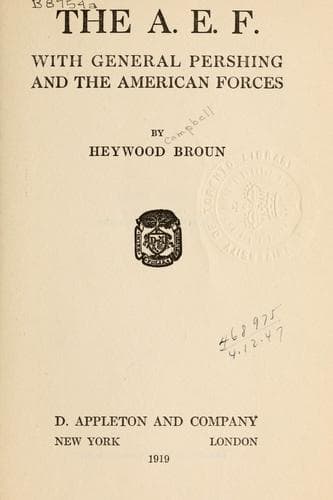
The A. E. F.: With General Pershing and the American ForcesBroun, Heywood
History
The A. E. F.: With General Pershing and the American Forces
Broun, Heywood
United States. Army. American Expeditionary Forces; World War, 1914-1918 -- Personal narratives
"Truly, I think they are very good," the Frenchman told me. Then he
corrected himself. "I mean I think they will be very good. They are
something like the Canadians. They were pretty jumpy at first, but that
doesn't do any harm. The soldiers up there, they wanted to fire when the
grass was moving and they did sometimes, without getting any orders.
They got over that pretty soon. By the third night they were pretty
well settled. Of course, they can shoot better than our men and they are
bigger and stronger, but in some things we have the advantage. You
Americans are much more excitable than we French."
As a rule French and British officers were inclined to be optimistic
about the Americans. They were impressed by their physique. The first of
the Canadians were probably a little huskier than the Americans and the
early contingents of Australians and New Zealanders were at least as
good, but now all the rest are falling off in their physical standards
on account of losses, while the most recent American arrivals in France
are better than any of our earlier contingents.
The American is potentially a good soldier, but it is a long cry of
preëminence. Any nation which establishes itself as the best in the
field will have to perform marvelous deeds. The chances are that nobody
will touch the high water mark of the French. After all, in her finest
moments, France has a positive genius for warfare. Her best troops
possess a combination of patience in defense and dash in attack. France
has a fighting tradition which we do not possess. We must gain that
before we can rival her.
From the point of view of the newspaperman the Frenchman is the ideal
soldier of the world. Not only can he fight, but he can tell you about
it. There is no trouble in getting a poilu to talk. He has opinions on
every subject under the sun. The only difficulty is in understanding him
once you have got him started. The doughboys, on the other hand, are
usually reticent. They're always afraid of being detected in some
sentimental or heroic pose and so they adopt a belittling attitude
toward anything which happens as protection. The first men who came back
from the trenches were not quite like that. These doughboys were more
like Rossetti's angels. "The wonder was not yet quite gone from that
still look" of theirs.
They did not minimize their experiences. I think I understand now what
Secretary Baker meant when he said that some of the most thrilling
stories of the war would come in letters from the soldiers. We went to
the major of a battalion which had just come back from the front to its
billets.
"No, nothing much happened while we were up there," he said. "They
didn't shell us very hard; they didn't try any raids or any gas and the
aeroplanes let us alone."
Public-domain text, read in full here on John Shaqi.
Reviews
Reviews
No reviews yet
Be the first to share your thoughts on this work.
Elsewhere in the archive
Join the Discussion
Join the discussion
Sign in to leave a comment or review.
Sign InorCreate an account