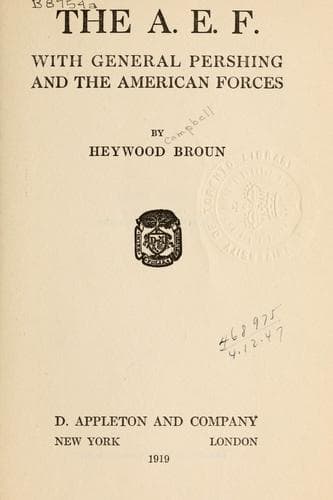
The A. E. F.: With General Pershing and the American ForcesBroun, Heywood
History
The A. E. F.: With General Pershing and the American Forces
Broun, Heywood
United States. Army. American Expeditionary Forces; World War, 1914-1918 -- Personal narratives
He must have heard somehow or other about the coming of the Americans
for he left the Germans at noon one day when the doughboys had hardly
become settled in their new home. A French interpreter vouched for him
and he was allowed free access to third line, second line, first line
and, what he valued much more, to the company kitchen. Here for the
first time he tasted slum. Soldiers are fond of belittling this
combination of beef, onions, potatoes and carrots but Quatre Cent Vingt
was frank in his admiration of the dish. Naturally, free-born American
citizens could not be expected to know him by his outlandish French
name or any abbreviation of it and he became Big Ed in honor of the mess
sergeant. Hitherto Quatre Cent Vingt had been careful to show no favors.
He had been the company's dog but he became so distinctly partial to the
mess sergeant that the soldier took him over as his own and when the
company went away Quatre Cent Vingt went too, following closely behind a
rolling kitchen.
The experience in the trenches made American soldiers a little more
expressive than they had been before but the national character remained
baffling. As a nation we unquestionably have personality but our army is
somewhat lacking in this quality even among its leaders. Pershing is a
personality, of course, and Bullard and Sibert and March, but for the
rest all major generals seemed much alike to us. Sibert we remembered
because he was a quiet, kindly man who got the things he wanted without
much fuss. He was among the thinkers of the army. Mostly he was
listening to other people, but when he talked he wasted no words.
Undoubtedly he was one of the best loved men in the army for he combined
with his efficiency and his kindliness an occasional playful flash of
humor. I remember a visit which three American newspaperwomen paid to
him one day at his headquarters. The conversation had scarcely begun
when one of the women somewhat tactlessly remarked, "General, this is a
young man's war, isn't it?"
General Sibert is husky enough but he is a bit gray and he smiled
quizzically as he looked at his questioner over the top of a big pair of
horn-rimmed glasses.
"When I was a cadet at West Point," said General Sibert, "I used to
console myself with the thought that Napoleon was winning battles when
he was thirty. Now, I find that my mind dwells more on the fact that
Hindenburg is seventy."
Public-domain text, read in full here on John Shaqi.
Reviews
Reviews
No reviews yet
Be the first to share your thoughts on this work.
Elsewhere in the archive
Join the Discussion
Join the discussion
Sign in to leave a comment or review.
Sign InorCreate an account