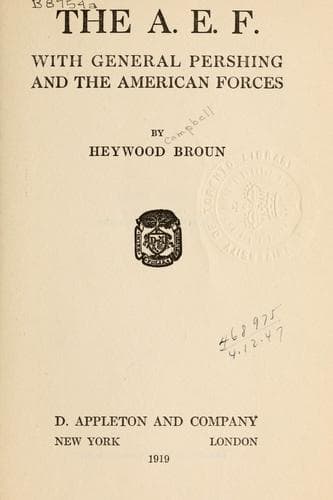
The A. E. F.: With General Pershing and the American ForcesBroun, Heywood
History
The A. E. F.: With General Pershing and the American Forces
Broun, Heywood
United States. Army. American Expeditionary Forces; World War, 1914-1918 -- Personal narratives
"The Lord was angered by this impiety and He promptly changed the farmer
into a frog. His wife could tell that it was her husband all right
because he was bigger than any of the other frogs and more noisy. She
went to the edge of the pond every day and prayed that her husband might
be forgiven. And one morning--it was the first day of the second
year--the big frog suddenly began to swell and get bigger and bigger
until he wasn't a frog any more, but a man. And he hopped out of the
pond and stood on the bank beside his wife. Without stopping to kiss her
or thank her or anything he ran straight into the house and came out
with a valise in his hand.
"'Where are you going?' his wife asked in terror.
"'To Seville,' he said.
"She wrung her hands. 'You mean God willing,' she cried.
"'No,' thundered the farmer, 'to Seville or back to the frog pond!'"
In the main, however, American officers and soldiers were not very
successful in expressing their feelings and ideals in regard to the war.
One of the Y. M. C. A. huts carried on an anonymous symposium on the
subject "Why I joined the army." Only a few of the answers came from the
heart. Most of the rest were of two types. One sort was swanking and
swaggering, in which the writer unconsciously melodramatized himself,
and the other was cynical, in which the writer betrayed the fact that he
was afraid of being melodramatic. Thus there was one man who answered,
"To fight for my country, the good old United States, the land of the
free and the starry flag that I love so well." "Because I was crazy,"
wrote another and it is probable that neither reason really represented
the exact feeling of the man in question.
Some were distinctly utilitarian such as that of the soldier who wrote
"To improve my mind by visiting the famous churches and art galleries of
the old world." There was also a simplicity and directness in "to put
Malden on the map." But the two which seemed to be the truest of all
were, "Because they said I wasn't game and I am too" and "Because she'll
be sorry when she sees my name in the list of the fellows that got
killed."
For a time I was all muddled up about the American reaction to the war.
Sometimes we seemed helplessly provincial and then along would come some
glorious unhelpless assertiveness. This would probably be in something
to do with plumbing or doctoring. Even our friends in Europe are
inclined to put us down as materialists. They think we love money more
than anything else in the world. I don't believe this is true. I think
we use money only as a symbol and that even if we don't express them, or
if we express them badly, the American who fights has not forgotten to
pack his ideals. A young American officer brought that home to me one
day in Paris. He was a doctor from a thriving factory town upstate.
Public-domain text, read in full here on John Shaqi.
Reviews
Reviews
No reviews yet
Be the first to share your thoughts on this work.
Elsewhere in the archive
Join the Discussion
Join the discussion
Sign in to leave a comment or review.
Sign InorCreate an account