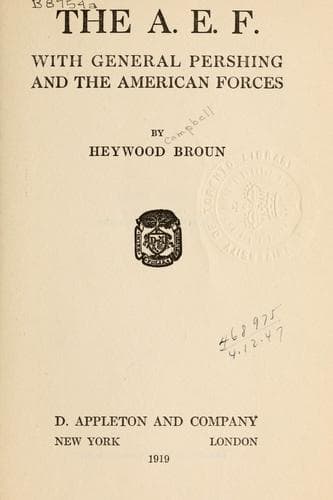
The A. E. F.: With General Pershing and the American ForcesBroun, Heywood
History
The A. E. F.: With General Pershing and the American Forces
Broun, Heywood
United States. Army. American Expeditionary Forces; World War, 1914-1918 -- Personal narratives
We neared the entrance to the tune of some trumpet blasts, not very well
played, and we peered from arch to inner court yard just in time to see
a swarm of khaki-half-clad soldiers running out from barracks. By the
time they reached the mess door they were khaki-clad. The officer who
came to take us about explained that on Sunday mornings everybody slept
late and dressed on the way to breakfast and that discipline was better
on week days. Then he told us that of all the privates in that unit not
one had ever been a soldier before. They had been picked for medical
service first and military service at such time as the officers had
learned enough to teach it to them. I remember later that one of the
soldiers objected privately to being drilled by a dentist.
Nine-tenths of the men were fresh out of college, the officer told us,
and half the other tenth were freshmen or sophomores. Many of the
enlisted men, we were told, had left incomes in the tens of thousands
and a few in the hundreds of thousands. The enlisted personnel included
one matinee idol, one young New York dramatic critic, two middling well
known young authors, a composer of good but saleable music, and a golfer
who gets two in the national rating.
The wards were not very different from those of a New York hospital
back home, except that they housed a strange mixture of patients. About
half were American soldiers and the rest were civilians from the country
round about. The French civilians were convinced that though the
American doctors might cure them with their marvelous medicines and
speckless cleanliness they would surely kill them with air. This
particular base hospital was fulfilling two functions for the civilian
population. It was seeking to take out adenoids and let in air. A great
New York specialist was attending to the adenoids and making progress.
It was not always possible to convince the patient that it would do him
any good to have his adenoids removed, but if the operation gave the
kind American doctor any pleasure he was willing to let him go ahead.
The air campaign was making slower progress. Dislike of air is centuries
old in France and it has become an instinct with the race. I rode in a
railroad car with a French aviator on a balmy day of early autumn and
his first act upon entering the compartment was to close both windows.
Everybody in this part of France has his bed placed inside a closet and
at night he closes the doors.
Worst of all were the extra precautions against air which the French
peasants took in case of illness. The young French doctors were at the
front and the old men who remained always began the treatment of a case
by advising the patient's relatives to close all the windows and start a
fire.
Public-domain text, read in full here on John Shaqi.
Reviews
Reviews
No reviews yet
Be the first to share your thoughts on this work.
Join the Discussion
Join the discussion
Sign in to leave a comment or review.
Sign InorCreate an account