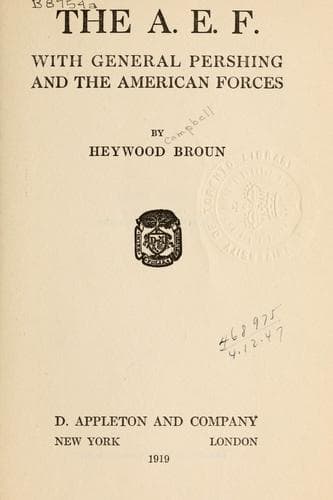
The A. E. F.: With General Pershing and the American ForcesBroun, Heywood
History
The A. E. F.: With General Pershing and the American Forces
Broun, Heywood
United States. Army. American Expeditionary Forces; World War, 1914-1918 -- Personal narratives
At the call of sick babies and old folk of the countryside came
aristocrats of the New York medical profession whose fees at home would
have bought the house in which the patient lived. Later, of course, the
doctors of the hospital will be more rushed by the necessities of the
soldiers.
"This is hardly more than a germ of what we plan," a doctor explained to
us. "Do you see those tents?" He pointed across a small field. "Those
are American engineers and they're going to do nothing for the next few
months but build additions to this hospital. Every time I go 'way for a
day I come back to find that they've added a thousand beds to the
capacity we're planning for. We will extend all the way across the
fields over to that road before they're done with us." He spoke in a
joyful voice as if nothing in the world was quite so inspiring as a huge
hospital filled with patients. That was the professional touch. I
remember the story one of the doctors told us about a young surgeon who
was sent up to the French front to help handle the cases after a big
drive. One of his first patients was a German prisoner who had been shot
just above the elbow and bayoneted in the stomach. The doctor had no
great trouble with the elbow and he did what he could for the abdominal
wound.
"I could save that man all right if it wasn't for that bayonet wound,"
he said to another American doctor close at hand, and then he added in a
reproachful voice as he pointed to the gash: "That's an awful dangerous
place to stab a man."
There were no wounded at the hospital at the time of our visit, but some
of the soldiers in the medical ward were very sick. There was one boy
there, who has since mended and gone away, whose recovery seemed
hopeless. The doctor in charge saw that something was troubling the
young soldier and so he came to him and told him that he was aggravating
his illness by this worry or desire.
"Whatever this thing is, you must tell me," said the doctor.
"Do you think I'm going to die?" the boy asked anxiously.
"Oh, I wouldn't say that," the doctor answered a little evasively.
"I knew I was pretty sick," said the boy, catching the evasiveness of
the doctor's tone, "and if you think I'm going to die and won't ever get
back home again, there's just one thing I want to ask you to do for me."
"What's that?" said the doctor.
"Couldn't you fix it up for me just once to have ham and eggs and apple
pie for breakfast?"
The most important thing in the case of all the sick men was to keep
them from brooding about home. The doctors made a point of getting
around and talking to the patients to cheer them up. One of them
complained of homesickness.
"Yes," said the doctor, "I suppose we all have people back there that we
miss."
"You can just bet I do," said the sick soldier, "I've got the finest
wife in the world in Des Moines and two children and a Ford."
Public-domain text, read in full here on John Shaqi.
Reviews
Reviews
No reviews yet
Be the first to share your thoughts on this work.
Join the Discussion
Join the discussion
Sign in to leave a comment or review.
Sign InorCreate an account