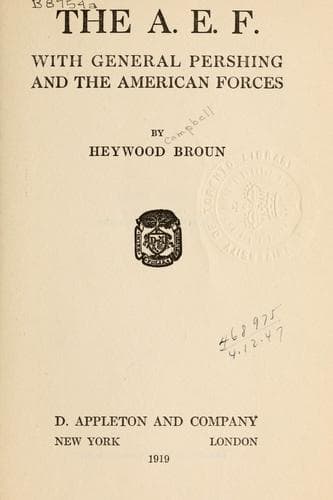
The A. E. F.: With General Pershing and the American ForcesBroun, Heywood
History
The A. E. F.: With General Pershing and the American Forces
Broun, Heywood
United States. Army. American Expeditionary Forces; World War, 1914-1918 -- Personal narratives
The health of the staff was excellent, but sometimes they felt homesick,
too. The enlisted men gave a show the night I was at the hospital and
during the course of the performance everybody wept or at least got
moist eyed because the play was about New York. It was laid in a year as
nameless as the place where the hospital is located. All the program
said was: "The bachelor apartments of Schuyler Van Allen on a fine June
night a few weeks after the end of the war." Schuyler had just come back
from Europe and he found his apartment with everything just as it was on
the night he had sailed for France. There was the daily paper he had
left behind with the date May 8, 1917, and he looked at the old sheet
and mused as he read some of the headlines:
"Kaiser Calls on Troops to Stand Firm," read Schuyler. "The Kaiser," he
said to himself, and then he added: "I wonder whatever became of him."
The audience laughed at that, but in a moment the doctors and the nurses
and the patients who weren't sick enough to stay in bed wept. It was all
because Schuyler looked out of the window and said to his friend: "Oh,
it's great to be on Fifth Avenue again. I want to see it in every light
and at every hour of the day. It was fairly blazing tonight with the
same old hurrying crowd jamming the traffic at Forty-second Street and
the same old mob pushing and shoving its way into the Grand Central
subway station." The mention of the subway was too much for the
audience. By this time the nurse who sat in front of me was dabbing
violently at her eyes with her pocket handkerchief. She was breaking my
heart and I leaned forward and asked: "What part of New York do you come
from?"
"I wasn't ever in New York," she said. "I come from Lima, Ohio."
Like the medical corps, the engineers were peculiarly American and
peculiarly efficient as well. We first came upon them when we saw a
tall, stringy man looking out of the window of a little locomotive which
pulled a train up to a point at the French front. We thought he was an
American because his jaws were moving back and forth slowly and
meditatively. Inquiry brought confirmation.
"Sure, I'm an American," said the man in the blue jumpers. "I guess I've
kicked a hobo off the train for every telegraph pole back on the old
Rock Island, but this is the toughest railroading job I've struck yet."
The man in the locomotive was a member of an American regiment of
railroad engineers which had taken over an important military road. They
had the honor to be the first American troops at the French front who
came under fire. The engineers were willing to admit that while washouts
and spreading rails were old stories to them, they did get a bit of a
thrill the first time they found their tracks torn up by shellfire. But
the aeroplanes were worse.
Public-domain text, read in full here on John Shaqi.
Reviews
Reviews
No reviews yet
Be the first to share your thoughts on this work.
Join the Discussion
Join the discussion
Sign in to leave a comment or review.
Sign InorCreate an account