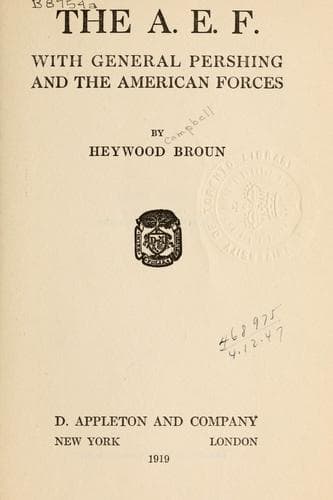
The A. E. F.: With General Pershing and the American ForcesBroun, Heywood
History
The A. E. F.: With General Pershing and the American Forces
Broun, Heywood
United States. Army. American Expeditionary Forces; World War, 1914-1918 -- Personal narratives
WE VISIT THE FRENCH ARMY
"The Germans haven't thrown a single shell into Rheims today," said our
conducting officer apologetically. "Yesterday," he continued more
cheerfully, "they sent more than five hundred big ones and they wounded
two of my officers."
We left the little inn at the fringe of the town and rode into the
square in front of the cathedral. At the door the officer turned us over
to the curator. The old man led us up the aisle to a point not far from
the altar. Here he stopped, and pointing to a great shell hole in the
floor said: "On this spot in the year 496 Clovis, the King of the
Franks, was baptized by the blessed St. Remi with oil which was brought
from heaven in a holy flask by a dove."
Something flew over the cathedral just then, but we knew it was not a
dove. It whistled like a strong wind, and presently the shop of a
confectioner some ten blocks away folded up with a ripping, smashing
sound. Clovis, with his fourteen centuries wrapped about him, was safe
enough. He had quit the spot in time. But a younger man ducked. The old
guide did not even look up.
"The first stone of the present cathedral was laid in May, 1212, by the
Archbishop Alberic de Humbert," he said.
Another big shell tore the sky, and this time the smash was nearer. It
seemed certainly no more than nine blocks away. The young man began to
calculate. He figured that he was seven centuries down, while the
Germans had nine blocks to go. That was something, but the guide failed
to keep up his pace through the centuries. There were no more happy
hiatuses.
"Scholars dispute," he continued, "as to who was the architect of the
cathedral. Some say it was designed by Robert de Coucy; others name
Bernard de Soissons, but certain authorities hold to Gauthier de Reims
and Jean d'Orbais." Two more shells crossed the cathedral. The
controversy seemed regrettable and the young man shifted constantly from
foot to foot. He appeared to feel that there was less chance of being
hit if he were on the wing, so to speak.
"One or two have named Jean Loups," said the guide, but he shook his
head even as he mentioned him. It was evident that he had no patience
with Loups or his backers. Indeed, the heresy threw him off his stride,
and the next smash which came during the lull was more significant than
any of the others. The crash was the peculiarly disagreeable one which
occurs when a large shell strikes a small hardware store. Even the guide
noticed this shell. It reminded him of the war.
"Since April," he said, "the Germans have been bombarding Rheims with
naval guns. All the shells which they fire now are .320 or larger. They
fire about 150 shells a day at the city, mostly in the afternoon, and
they usually aim at the cathedral or some place near by."
The young man noted by his watch that it was just half-past one.
Public-domain text, read in full here on John Shaqi.
Reviews
Reviews
No reviews yet
Be the first to share your thoughts on this work.
Join the Discussion
Join the discussion
Sign in to leave a comment or review.
Sign InorCreate an account