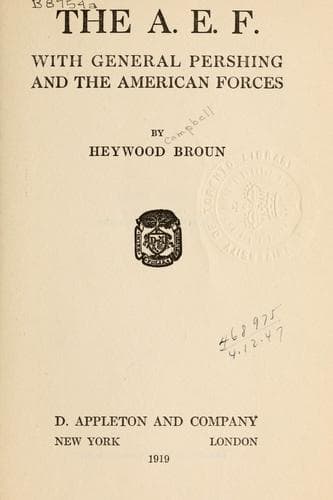
The A. E. F.: With General Pershing and the American ForcesBroun, Heywood
History
The A. E. F.: With General Pershing and the American Forces
Broun, Heywood
United States. Army. American Expeditionary Forces; World War, 1914-1918 -- Personal narratives
"A week ago the Germans fired a .320 shell through the roof, but it did
not explode. I will show it to you, but first I must ask you to touch
nothing, not even a piece of glass, for we want to put everything back
again that we can after the war."
On the floor there was evidence that some patient hand had made a
beginning of seeking to fit together in proper sequence all the
available tiny glass fragments from the shattered rose windows. It was a
pitiful jigsaw puzzle, which would not work. The curator stepped briskly
up the nave, and at the end of a hundred paces he stopped.
"This is the most dangerous portion of the cathedral," he explained.
"Most of the big shells have come in here." And he pointed to three
great holes in the ceiling. Then he showed us the monstrous shell which
had not exploded and the fragments of others which had. Down toward the
west end of town fresh fragments were being made. Each hole in the
cathedral roof sounded a different note as the shells raced overhead.
But the old curator was musing again. He had forgotten the war, even
though the smashed and twisted bits of iron and stone from yesterday's
clean hit lay at his feet.
"The first stone of the present cathedral was laid in May, 1212, by the
Archbishop Alberic de Humbert," he said. "Alberic gave all the money he
could gather and the chapter presented its treasury, and all about the
clergy appealed for funds in the name of God. Kings of France and mighty
lords made contributions, and each year there was a great pilgrimage,
headed by the image of the Blessed Virgin, through all the villages. And
the building grew and sculptors from all parts of France came and
embellished it and in 1430 it was finished. You see, gentlemen," he
said, "it took more than two hundred years to build our cathedral."
We left the cathedral then and paused for a minute in the square before
the statue of Jeanne d'Arc, who brought her king to Rheims and had him
crowned. In some parts of France devout persons speak of the Jeanne
statue in Rheims as a miracle because, although the cathedral has been
scarred and shattered and every building round the square badly
damaged, the statue of Jeanne is untouched. I looked closely and found
the miracle was not perfect. A tiny bit of the scabbard of Jeanne had
been snipped off by a flying shrapnel fragment, but the sword of Jeanne,
which is raised high above her head, has not a nick in it.
Public-domain text, read in full here on John Shaqi.
Reviews
Reviews
No reviews yet
Be the first to share your thoughts on this work.
Join the Discussion
Join the discussion
Sign in to leave a comment or review.
Sign InorCreate an account