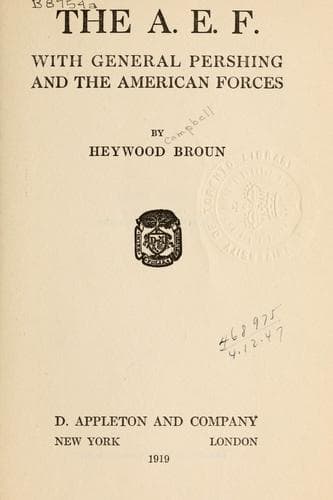
The A. E. F.: With General Pershing and the American ForcesBroun, Heywood
History
The A. E. F.: With General Pershing and the American Forces
Broun, Heywood
United States. Army. American Expeditionary Forces; World War, 1914-1918 -- Personal narratives
Trenches, save in the very active sectors, give the visitor a sense of
security. Open places are the ones which try the nerves of civilians,
and it was pleasant to walk with a wall of earth on either hand, even if
some of us did have to stoop a bit. From the point where we entered the
communication trench to the front line was probably not more than half a
mile as the crow flies--if, indeed, he is foolish enough to travel over
trenches--but the sunken pathway turned and twisted to such an extent
that it must have been two miles before we struck even the third line.
Here we were held while ever so many dugouts and kitchens and gas alarm
stations and telephones were exhibited for us. They were all included in
the routine of war, but of a sudden romance popped up from underground.
The conducting officer paused at the entrance of a passage. "Another
dugout" we thought.
"Bring them up!" said the officer to a soldier, and the poilu scrambled
down the steps and came up with a bird cage containing two birds.
"These are the last resort," explained the officer. "We send messages
from the trenches by telephone, if we can. If the wires are destroyed we
use flashes from a light, but if that station is also broken and we must
have help the birds are freed."
Neither pigeon seemed in the least puffed up over the responsibility
which rested upon him.
The German trenches were just 400 yards away from the first lines of the
French. It was possible to see them by peering over the rim of the
trench, but we quickly ducked down again. Presently we grew less
cautious, and one or two tried to stare the Germans out of countenance.
If they could see that strangers were peeping at them they paid no
attention.
The French officer in charge seemed embarrassed. He explained that it
was an exceptionally quiet day. Only the day before the Germans had been
active with trench mortars, and he couldn't understand why they were
sulking now. Possibly the bombardment from the French .75's, which had
been going on all day, had softened them a bit. He looked about the
trench dejectedly. The soldiers of the front line were playing cards,
eating soup or modeling little grotesque figures out of the soft rock
which lined the walls of the trenches. He called sharply to a soldier,
who fetched a box of rifle grenades out of a cubbyhole and sent half a
dozen, one after the other, spinning at the German lines. Probably they
fell short, or perhaps the Germans were simply sullen. At any rate, they
paid no attention. They were not disposed into being prodded to show
off for American visitors.
Public-domain text, read in full here on John Shaqi.
Reviews
Reviews
No reviews yet
Be the first to share your thoughts on this work.
Elsewhere in the archive
Join the Discussion
Join the discussion
Sign in to leave a comment or review.
Sign InorCreate an account