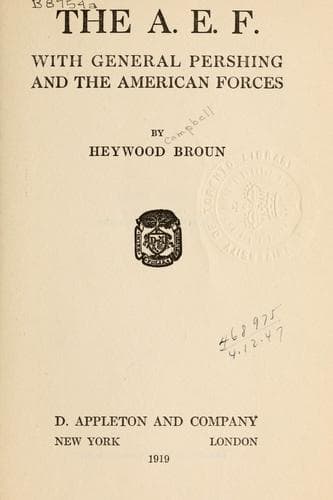
The A. E. F.: With General Pershing and the American ForcesBroun, Heywood
History
The A. E. F.: With General Pershing and the American Forces
Broun, Heywood
United States. Army. American Expeditionary Forces; World War, 1914-1918 -- Personal narratives
One is always taken from the cathedral of Rheims to the wine cellars.
The children of darkness are invariably wiser than the children of light
and the champagne merchants have not suffered as the churchmen have.
Their business places have been knocked about their heads, but their
treasures are underground deep enough to defy the biggest shells. In the
cellar of a single company which we visited there were 12,000,000 quarts
of wine. Even the German invasion at the beginning of the war failed to
deplete this stock. Hundreds of people live in these cellars, which are
laid out in avenues and streets. We came first to New York, a street
with tier upon tier of wine bottles; then to Boston, then to Buenos
Ayres, then to Montreal. One of the visitors explained that the street
named New York contained the wine destined to be shipped to that city,
while Buenos Ayres contained the consignment for the Argentine capital,
and so on. We nodded acceptance of the theory, but the next wine-laden
street was called Carnot and the next was Jeanne d'Arc.
From the cellars we made a journey to a battery of French .75's. It was
a peaceful military station, for so well were the guns concealed that
they seemed exempt from German fire, in spite of the fact that they had
been in place for half a year. The men sat about underground playing
cards and reading newspapers, but the commander of the battery was
unwilling that we should go with such a peaceful impression of his guns.
He brought his men to action with a word or two and sent six shells
sailing at the German first line trenches for our benefit. We left, half
deafened, but delighted.
No child could be more eager to show a toy than is a French officer to
let a visitor see in some small fashion how the war wags. We went from
the battery to a first line trench. It was slow work down miles and
miles of camouflaged road to the communicating trench, and all along the
line we were stopped by kindly Frenchmen, who wanted us to see how their
dugouts were decorated or the nature of their dining room or the first
aid dressing station or any little detail of the war with which they
were directly concerned. Much can be done with a dugout when a few back
numbers of _La Vie Parisienne_ are available. Still, this scheme of
decoration may be carried too far. I will never forget the face of a Y.
M. C. A. man who joined us at a French officers' mess one day. It was a
low ceilinged room, with pine walls, but not an inch of wall was
visible, for a complete papering of _La Vie Parisienne_ pictures had
been provided. Among the ladies thus drafted for decorative purposes
there was perhaps chiffon enough to make a single arm brassard.
Public-domain text, read in full here on John Shaqi.
Reviews
Reviews
No reviews yet
Be the first to share your thoughts on this work.
Elsewhere in the archive
Join the Discussion
Join the discussion
Sign in to leave a comment or review.
Sign InorCreate an account