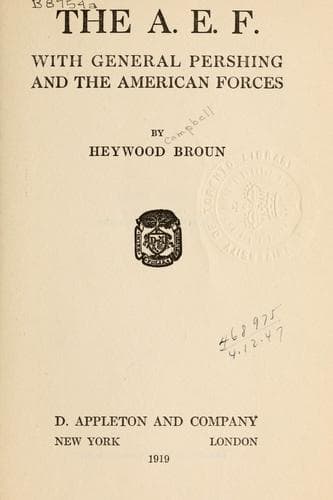
The A. E. F.: With General Pershing and the American ForcesBroun, Heywood
History
The A. E. F.: With General Pershing and the American Forces
Broun, Heywood
United States. Army. American Expeditionary Forces; World War, 1914-1918 -- Personal narratives
Our guide and mentor at Verdun was a distinguished colonel, very
learned in military tactics and familiar with every phase of the various
Verdun campaigns. The extent of his information was borne home to us the
first day of the trip, for he stood the party on top of Fort Souville
and carried on a technical talk in French for more than half an hour,
while German shells, breaking a few hundred yards away, sought in vain
to interrupt him.
From the top of Souville it was possible to see gun flashes and to spy,
now and again, aeroplanes which darted back and forth all day, but not a
soldier of either side was to be seen through the strongest glasses. On
no front have men dug in so deeply as at Verdun. They have good reason
to snuggle into the earth, for the French have a story that one of their
projectiles killed men in a dugout seventy-five feet below the surface.
They thought that this terrific penetration must have been due to the
fact that the shell hit fairly upon a crack in the concrete and wedged
its way through.
Barring plumbing, which is always an after thought in France, the French
make the underground dwellings of the soldiers moderately comfortable.
There are ventilating plants and electric lights, and in the citadel a
motion picture theater. In one underground stronghold we found the
telephone central for all the various positions around Verdun. We
wondered whether or not he was ever obliged to report, "Your party
doesn't answer."
We traveled far underground, and at last the colonel brought us out
again near the high, bare spot where the automobiles had been left. As
we walked down the road there was a particularly vicious bang some place
to our left.
"That wasn't very far away," said the colonel.
This was the first shell which had stirred him to interest or attention.
Presently there came another bang, and this seemed just as loud. The
colonel paused thoughtfully.
"Maybe one of their aeroplanes has seen us and spotted us for the
artillery," he said. "Tell the chauffeurs to turn the cars around at
once, and we'll go."
The chauffeurs turned the cars with commendable alacrity and the
colonel walked slowly toward them. But his roving glance rested for an
instant upon a little ridge across the valley to his left which brought
memories to his mind and he stopped in the middle of the road and began:
"In the Spring of 1915----" On and on he went in his beautiful French
and described some small affair which might have influenced the entire
subsequent course of events. It seemed that if the Germans had varied
their plan a little the French defensive scheme would have been upset
and all sorts of things would have happened. At the end of twenty
minutes he had done full justice to the subject and then he recollected.
"We'd better go now," he said, "the Germans may have spotted us."
Public-domain text, read in full here on John Shaqi.
Reviews
Reviews
No reviews yet
Be the first to share your thoughts on this work.
Elsewhere in the archive
Join the Discussion
Join the discussion
Sign in to leave a comment or review.
Sign InorCreate an account