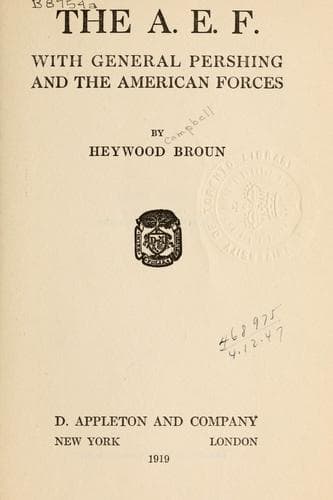
The A. E. F.: With General Pershing and the American ForcesBroun, Heywood
History
The A. E. F.: With General Pershing and the American Forces
Broun, Heywood
United States. Army. American Expeditionary Forces; World War, 1914-1918 -- Personal narratives
"If they'd cut out wire and trenches and machine guns and general
staffs," said the little major, "we'd win in two months." Without these
concessions he did not expect to see the end for at least a year.
However, he was concerned for the most part with more concrete things
than predictions, and I'd best let him wander on as he did that
afternoon with no interruption save an occasional question. He was
returning to the front after being wounded. There had been boating and
swimming and tennis and "a deuced pretty girl" down there at the resort
where he had been recuperating, and yet he was glad to be back.
"You see," the little major explained, "I have been in all the shows
from the beginning and I'd feel pretty rotten if they were to pull
anything off without me. The C.O. wants me back. I have a letter here
from him. He tells me to take all the time I need, but to get back as
soon as I can. The C.O. and I have been together from the beginning. It
isn't that the new fellow isn't all right. Quite likely he's a better
officer than I am, but the C.O. wants the old fellows that he's seen in
other shows and knows all about. That's why I want to get back. I want
to see what the new fellow's doing with my men."
He limped a little still, and I pressed him to tell me about his wound.
It seemed he got it in "the April show."
"There was a bit of luck about that," he said. "I happened to take my
Webley with me when we went over, as well as my cane. They've got a
silly rule now that officers mustn't carry canes in an attack and that
they must wear Tommies' tunics, so the Fritzies can't spot them. They
say we lose too many officers because they expose themselves. Nobody
pays much attention to that rule. You won't find many officers in
Tommies' tunics, but you will find 'em out in front with their canes.
"And there's sense to it. I've always said that I wouldn't ask my men to
go any place I wasn't willing to go and to go first. 'Come on,' that's
what we say in the British army. The Germans drive their men from
behind. Some of their officers are very brave, you know, but that's the
system. I remember in one show we were stuck at the third line of barbed
wire. The guns hadn't touched it, but it wasn't their fault. There was a
German officer there, and he stood up on the parapet, and directed the
machine gun fire. He'd point every place we were a little thick and then
they'd let us have it. We got him, though. I got a machine gunner on
him. Just peppered him. He was a mighty brave officer."
I reminded the little major that I wanted to hear about his wound.
"We were coming through a German trench that had been pretty well
cleaned out, but close up against the back there was a soldier hiding.
When I came by he cut at me with his bayonet. He only got me in the
fleshy part of my leg, and I turned and let him have it with my Webley.
Blew the top of his head right off. Silly ass, wasn't he? Must have
known he'd be killed."
Public-domain text, read in full here on John Shaqi.
Reviews
Reviews
No reviews yet
Be the first to share your thoughts on this work.
Elsewhere in the archive
Join the Discussion
Join the discussion
Sign in to leave a comment or review.
Sign InorCreate an account