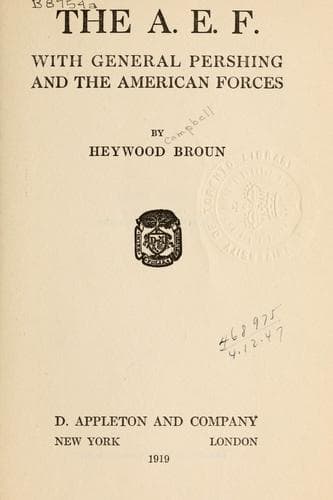
The A. E. F.: With General Pershing and the American ForcesBroun, Heywood
History
The A. E. F.: With General Pershing and the American Forces
Broun, Heywood
United States. Army. American Expeditionary Forces; World War, 1914-1918 -- Personal narratives
I asked him if his wound hurt, and he said no, and that he was able to
walk back, and felt quite chipper until the last mile.
"The first thing a wounded man wants to do," he explained, "is to get
away. If he's been hit he gets a sudden crazy fear that he's going to
get it again. Most wounds don't hurt much, and as soon as a man's out of
fire and puts a cigarette in his mouth he cheers up. He's at his best if
it's a blighty hit."
Here I was forced to interrupt for information.
"A blighty hit! Don't you know what that is? It's from the song they
sing now, 'Carry Me Back to Blighty.' Blighty's England. I think it's a
Hindustani word that means home, but I won't be sure about that. Anyhow,
a blighty hit's not bad enough to keep you in France, but bad enough to
send you to England. Those are the slow injuries that aren't so very
dangerous.
"Next to getting to Blighty a fellow wants a cigarette. I never saw a
man hit so bad he couldn't smoke. I saw a British 'plane coming down one
day and the tail of it was red. The Germans fix up their machines like
that, but I knew this wasn't paint on a British plane. He made a tiptop
landing, and when he got out we saw part of his shoulder was shot away
and he had a hole in the top of his head. 'That was a close call,' he
said, and he took out a cigarette, lighted it and took two puffs. Then
he keeled over."
The little major and I got out to stretch our legs at a station
platform, and I noticed that salutes were punctiliously given and
returned. "I suppose," I said, quoting a bit of misinformation somebody
had supplied, "that out at the front all this saluting is cut out."
"No, sir," said the little major sternly. "Somebody told that to the
last batch of recruits that was sent over, but we taught 'em better
soon. They don't get the lay of it quite. It isn't me they salute; it's
the King's uniform. Of course, I don't expect a man to salute if I pass
him in a trench; but if he's smoking a cigarette I expect him to throw
it away and I expect him to straighten up.
"You've got to let up on some things, of course. There's shaving now. I
expect my men to shave every day when they're not in the line, but you
can't expect that in the trenches. Naturally, I shave myself every day
anyhow, but I'm lenient with the men. I don't insist on their shaving
more than every other day."
When I got to the château where the visiting correspondents stay I found
the officers at mess. There were four British officers, a Roumanian
general, a member of Parliament, a Dutch painter and an American
newspaperman. As at Verdun the conversation had swung around to
literature. It all began because somebody said something about Shaw
having put up at the château when he visited the front.
"Awful ass," said an English officer who had met the playwright out
there. "He was no end of nuisance for us. Why, when he got out here we
found he was a vegetarian, and we had to chase around and have
omelettes fixed up for him every day."
Public-domain text, read in full here on John Shaqi.
Reviews
Reviews
No reviews yet
Be the first to share your thoughts on this work.
Elsewhere in the archive
Join the Discussion
Join the discussion
Sign in to leave a comment or review.
Sign InorCreate an account