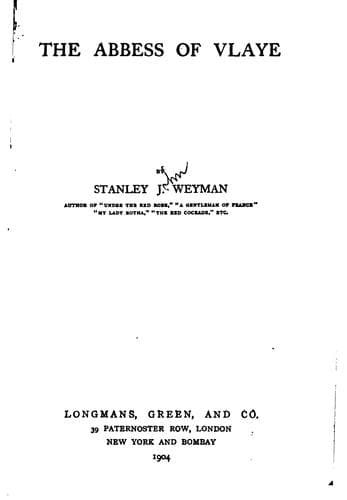
France -- History -- Henry IV, 1589-1610 -- Fiction; Historical fiction
But these and the like doubts arose not from compunction, but from
mistrust. Compunction was to come later, when evening fell and from
the door of the Duke's quarters she viewed the scene, now familiar, of
the hostages' departure in the dusk--saw the horses drawn up and the
two whom she was dooming in act to mount. It was then that a sudden
horror of what she was about seized her--she was young, a mere
girl--and she rose with a stifled cry from her stool. It was not yet
too late. A cry, a word would save them. Would save them still!
Impulsively she moved a pace towards them, intending--ay, for a
moment, intending to say that word.
But she stopped. A word would save them, but--she was forgetting--it
would doom her lover! And on that thought, and to reinforce it,
there rose before her mind's eye the pale puling features of the
Countess--her rival! Was she to be put aside for a thing like that?
Was it to such a half-formed child as that she must surrender her
lover? She pressed her hands together, and, returning to her seat, she
turned it about that her eyes might not see them as they went through
the dusk.
CHAPTER XVII.
THE HEART OF CAIN.
Seven hours had passed.
The moon had just dropped below the narrow horizon of the camp, but to
eyes which looked up from the blackness of the hollow the form of the
nearest sentinel, erect on the edge of the cup, showed plain against
the paler background of sky. The hour was the deadest of the night;
but, as the stillest night has its noises, the camp was not without
noises. The dull sound of horses browsing, the breath of a thousand
sleepers, the low whinny of a mare, or the muttered word of one who
dreamed heavily and spoke in his dream, these and the like sounds fed
a murmurous silence that was one with the brooding heaviness of a June
night.
Odette de Villeneuve--the ears that drank in the voices of the
slumbering host were hers--stood half-hidden in the doorway of her
quarters and listened. The inner darkness had become intolerable to
her. The wattled walls, though they were ventilated by a hundred
crevices, stifled her. Pent behind them she fancied a hundred things;
she saw on the curtain of blackness drawn faces and staring eyes; she
made of the faintest murmur that entered now a roar of voices, and now
the hoarse beginnings of a scream. Outside, with the cooler air
fanning her burning face, she could at least lay hold on reality. She
was no longer the sport and plaything of her own strained senses. She
could at least be sure that nothing was happening, that nothing had
happened--yet. And though she still breathed quickly and crouched like
a fearful thing in the doorway, here she could call hate to her
support, she could reckon her wrongs and think of her lover, and
persuade herself that this was but a nightmare from which she would
awake to find all well with herself and with him.
Public-domain text, read in full here on John Shaqi.
Reviews
Reviews
No reviews yet
Be the first to share your thoughts on this work.
Elsewhere in the archive
Join the Discussion
Join the discussion
Sign in to leave a comment or review.
Sign InorCreate an account