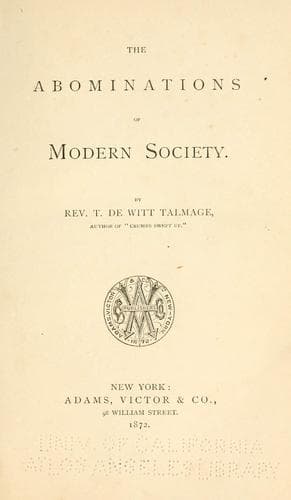
The Abominations of Modern SocietyTalmage, T. De Witt (Thomas De Witt)
Religion
The Abominations of Modern Society
Talmage, T. De Witt (Thomas De Witt)
Conduct of life
There is often hostility on the part of producers against traders,
as though the man who raises the corn were necessarily more honorable
than the grain dealer, who pours it into his mammoth bin. There ought
to be no such hostility. The occupation of one is as necessary as that
of the other. Yet producers often think it no wrong to snatch away
from the trader; and they say to the bargain-maker, "You get your
money easy." Do they get it easy? Let those who in the quiet field and
barn get their living exchange places with those who stand to-day amid
the excitements of commercial life, and see if they find it so very
easy. While the farmer goes to sleep with the assurance that his corn
and barley will be growing all the night, moment by moment adding to
his revenue, the merchant tries to go to sleep, conscious that that
moment his cargo may be broken on the rocks, or damaged by the wave
that sweeps clear across the hurricane deck; or that the gold gamblers
may, that very hour, be plotting some monetary revolution, or the
burglars be prying open his safe, or his debtors fleeing the town, or
his landlord raising the rent, or the fires kindling on the block that
contains all his estate. _Easy!_ is it? God help the merchants! It is
hard to have the palms of the hand blistered with out-door work; but a
more dreadful process when, through mercantile anxieties, the brain is
consumed!
In the next place we notice _mercantile_ lies, those before the
counter and behind the counter. I will not attempt to specify the
different forms of commercial falsehood. There are merchants who
excuse themselves for deviation from truthfulness because of what
they call commercial custom. In other words, the multiplication and
universality of a sin turns it into a virtue. There have been large
fortunes gathered where there was not one drop of unrequited toil
in the wine; not one spark of bad temper flashing from the bronze
bracket; not one drop of needle-woman's heart-blood in the crimson
plush; while there are other great establishments in which there is
not one door-knob, not one brick, not one trinket, not one thread of
lace, but has upon it the mark of dishonor. What wonder if, some day,
a hand of toil that had been wrung, and worn out, and blistered until
the skin came off, should be placed against the elegant wall-paper,
leaving its mark of blood,--four fingers and a thumb; or that,
some day, walking the halls, there should be a voice accosting the
occupant, saying, _Six cents for making a shirt_; and, flying the
room, another voice should say, _Twelve cents for an army blanket_;
and the man should try to sleep at night, but ever and anon be
aroused, until, getting up on one elbow, he should shriek out, _Who's
there?_
Public-domain text, read in full here on John Shaqi.
Reviews
Reviews
No reviews yet
Be the first to share your thoughts on this work.
Elsewhere in the archive
Join the Discussion
Join the discussion
Sign in to leave a comment or review.
Sign InorCreate an account