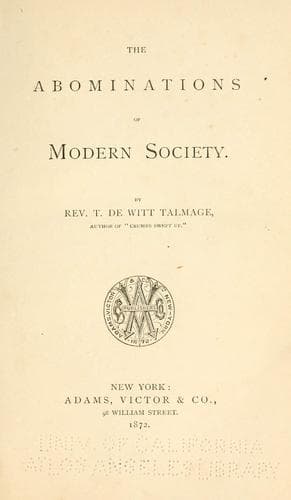
The Abominations of Modern SocietyTalmage, T. De Witt (Thomas De Witt)
Religion
The Abominations of Modern Society
Talmage, T. De Witt (Thomas De Witt)
Conduct of life
Intemperance soon stigmatizes its victim--kicking him out, a slavering
fool, into the ditch, or sending him, with the drunkard's hiccough,
staggering up the street where his family lives. But gambling does
not, in that way, expose its victims. The gambler may be eaten up by
the gambler's passion, yet only discover it by the greed in his eyes,
the hardness of his features, the nervous restlessness, the threadbare
coat, and his embarrassed business. Yet he is on the road to hell,
and no preacher's voice, or startling warning, or wife's entreaty, can
make him stay for a moment his headlong career. The infernal spell
is on him; a giant is aroused within; and though you bind him with
cables, they would part like thread; and though you fasten him seven
times round with chains, they would snap like rusted wire; and though
you piled up in his path, heaven-high, Bibles, tracts and sermons, and
on the top should set the cross of the Son of God, over them all the
gambler would leap like a roe over the rocks, on his way to perdition.
Again, this sin works ruin by killing industry.
A man used to reaping scores or hundreds of dollars from the
gaming-table will not be content with slow work. He will say, "What is
the use of trying to make these fifty dollars in my store when I can
get five times that in half an hour down at 'Billy's'?" You never knew
a confirmed gambler who was industrious. The men given to this vice
spend their time not actively employed in the game in idleness, or
intoxication, or sleep, or in corrupting new victims. This sin has
dulled the carpenter's saw, and cut the band of the factory wheel,
sunk the cargo, broken the teeth of the farmer's harrow, and sent a
strange lightning to shatter the battery of the philosopher.
The very first idea in gaming is at war with all the industries of
society. Any trade or occupation that is of use is ennobling. The
street sweeper advances the interests of society by the cleanliness
effected. The cat pays for the fragments it eats by clearing the house
of vermin. The fly that takes the sweetness from the dregs of the cup
compensates by purifying the air and keeping back the pestilence. But
the gambler gives not anything for that which he takes.
I recall that sentence. He _does_ make a return; but it is disgrace to
the man that he fleeces, despair to his heart, ruin to his business,
anguish to his wife, shame to his children, and eternal wasting away
to his soul. He pays in tears and blood, and agony, and darkness, and
woe.
What dull work is ploughing to the farmer, when in the village saloon,
in one night, he makes and loses the value of a summer harvest? Who
will want to sell tape, and measure nankeen, and cut garments, and
weigh sugars, when in a night's game he makes and loses, and makes
again, and loses again, the profits of a season?
Public-domain text, read in full here on John Shaqi.
Reviews
Reviews
No reviews yet
Be the first to share your thoughts on this work.
Elsewhere in the archive
Join the Discussion
Join the discussion
Sign in to leave a comment or review.
Sign InorCreate an account