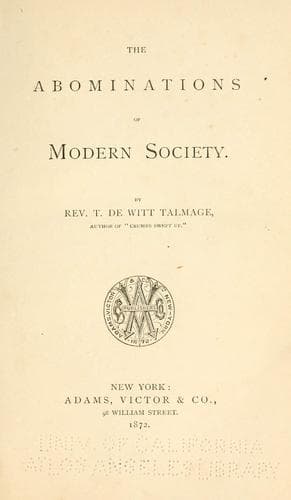
The Abominations of Modern SocietyTalmage, T. De Witt (Thomas De Witt)
Religion
The Abominations of Modern Society
Talmage, T. De Witt (Thomas De Witt)
Conduct of life
John Borack was sent as mercantile agent from Bremen to England and
this country. After two years his employers mistrusted that all was
not right. He was a defaulter for eighty-seven thousand dollars. It
was found that he had lost in Lombard street, London, twenty-nine
thousand dollars; in Fulton street, New York, ten thousand dollars;
and in New Orleans, three thousand dollars. He was imprisoned, but
afterwards escaped and went into the gambling profession. He died in a
lunatic asylum.
This crime is getting its pry under many a mercantile house in our
cities, and before long down will come the great establishment,
crushing reputation, home, comfort, and immortal souls. How it diverts
and sinks capital may be inferred from some authentic statements
before us. The ten gaming-houses that once were authorized in Paris
passed through the banks, yearly, three hundred and twenty-five
millions of francs! The houses of this kind in Germany yield vast sums
to the government. The Hamburg establishment pays to the government
treasury forty thousand florins; and Baden Baden one hundred
and twenty thousand florins. Each one of the banks in the large
gaming-houses of Germany has forty or fifty croupiers standing in its
service.
Where does all the money come from? _The whole world is robbed!_ What
is most sad, there are no consolations for the loss and suffering
entailed by gaming. If men fail in lawful business, God pities, and
society commiserates; but where in the Bible, or in society, is there
any consolation for the gambler? From what tree of the forest oozes
there a balm that can soothe the gamester's heart? In that bottle
where God keeps the tears of his children, are there any tears of the
gambler? Do the winds that come to kiss the faded cheek of sickness,
and to cool the heated brow of the laborer, whisper hope and cheer to
the emaciated victim of the game of hazard? When an honest man is in
trouble, he has sympathy. "Poor fellow!" they say. But do gamblers
come to weep at the agonies of the gambler? In Northumberland was one
of the finest estates in England. Mr. Porter owned it, and in a year
gambled it all away. Having lost the last acre of the estate, he came
down from the saloon and got into his carriage; went back; put up his
horses, and carriage, and town house, and played. He threw and
lost. He started home, and on a side alley met a friend from whom
he borrowed ten guineas; went back to the saloon, and before a great
while had won twenty thousand pounds. He died at last a beggar in St.
Giles. How many gamblers felt sorry for Mr. Porter? Who consoled him
on the loss of his estate? What gambler subscribed to put a stone over
the poor man's grave? Not one!
Public-domain text, read in full here on John Shaqi.
Reviews
Reviews
No reviews yet
Be the first to share your thoughts on this work.
Elsewhere in the archive
Join the Discussion
Join the discussion
Sign in to leave a comment or review.
Sign InorCreate an account