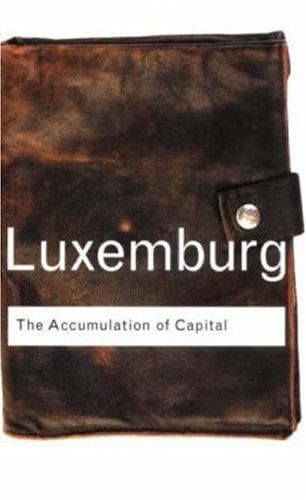
Capitalism; Imperialism; Saving and investment; Socialism
surplus value does not exist at all. Besides this major omission, it is
of small account that he, just like his disciple, takes no notice of
constant capital. He wants to solve the problem of realising the surplus
value and expanding capital without positing more than the existence of
a certain quantity of commodities which are mutually exchanged.
Sismondi was blind to the fact that the venue has been changed
altogether. Yet he tried faithfully to bring the fantasies of his famous
guest and opponent down to earth and to analyse their invisible
contradictions, plaintively saying that these assumptions, 'just like
German metaphysics, abstract from time and space'.[204] He grafts
Ricardo's hypothesis on to 'society in its real organisation, with
unpropertied workers whose wage is fixed by competition and who can be
dismissed the moment their master has no further need of their work ...
for'--remarks Sismondi, as acute as he is modest--'it is just this
social organisation to which our objection refers'.[205]
He lays bare the many difficulties and conflicts bound up with the
progress of labour productivity under capitalism, and shows that
Ricardo's postulated changes in the technique of labour, from the point
of view of society, lead to the following alternative: Either a number
of workers corresponding to the increase in labour productivity will
have to be dismissed outright--then there will be a surplus of products
on the one hand, and on the other unemployment and misery--a faithful
picture of present-day society. Or the surplus product will be used for
the maintenance of the workers in a new field of production, the
production of luxury goods. Here Sismondi undoubtedly proves himself
superior: he suddenly remembers the existence of the constant capital,
and now it is he who subjects the English classic to a frontal attack:
'For setting up a new industry for manufacturing luxuries, new capital
is also needed; machines will have to be built, raw materials procured,
and distant commerce brought into activity; for the wealthy are rarely
content with enjoying what is immediately in front of them. Where, then,
could we find this new capital which may perhaps be much more
considerable than that required by agriculture?... Our luxury workers
are still a long way from eating our labourers' grain, from wearing the
clothes from our common factories; they are not yet made into workers,
they may not even have been born yet, their trade does not exist, the
materials on which they are to work have not arrived from India. All
those among whom the former should distribute their bread, wait for it
in vain.'[206]
Public-domain text, read in full here on John Shaqi.
Reviews
Reviews
No reviews yet
Be the first to share your thoughts on this work.
Elsewhere in the archive
Join the Discussion
Join the discussion
Sign in to leave a comment or review.
Sign InorCreate an account