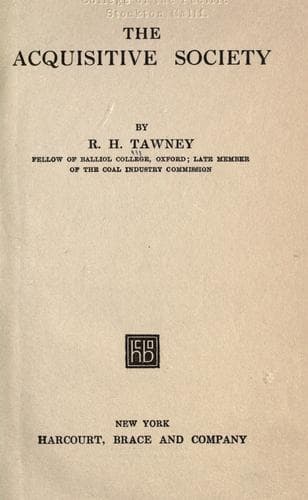
The Acquisitive SocietyTawney, R. H. (Richard Henry)
Philosophy
The Acquisitive Society
Tawney, R. H. (Richard Henry)
Economics; Industries; Social problems
persuasion, not by mere driving, to establish, in short, the same
relationships of comradeship and good will as ought to exist between
the colleagues in any common undertaking. But in all this there is
nothing to undermine his authority, unless "authority" be understood to
mean an arbitrary power which no man is fit to exercise, and which few
men, in their sober moments, would claim. The manager will be
appointed by, and responsible to, not the men whose work he supervises,
but the District Mining Council, which controls all the pits in a
district, and on that council he will be represented. Nor will he be
at the mercy of a distant "clerkocracy," overwhelming him with
circulars and overriding his expert knowledge with impracticable
mandates devised in London. The very kernel of the schemes advanced
both by Justice Sankey and by the Miners' Federation is decentralized
administration within the framework of a national system. There is no
question of "managing the industry from Whitehall." The
characteristics of different coal-fields vary so widely that reliance
on local knowledge and experience are essential, and it is to local
knowledge and experience that it is proposed to intrust the
administration of the industry. The constitution which is recommended
is, in short, not "Unitary" but "Federal." There will be a division of
functions and power between central authorities and district
authorities. The former will lay down general rules as to those
matters which must necessarily {170} be dealt with on a national basis.
The latter will administer the industry within their own districts,
and, as long as they comply with those rules and provide their quota of
coal, will possess local autonomy and will follow the method of working
the pits which they think best suited to local conditions.
Public-domain text, read in full here on John Shaqi.
Reviews
Reviews
No reviews yet
Be the first to share your thoughts on this work.
Elsewhere in the archive
Join the Discussion
Join the discussion
Sign in to leave a comment or review.
Sign InorCreate an account