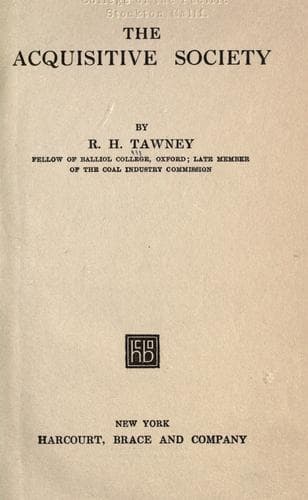
The Acquisitive SocietyTawney, R. H. (Richard Henry)
Philosophy
The Acquisitive Society
Tawney, R. H. (Richard Henry)
Economics; Industries; Social problems
The first change is necessary because the conduct of industry for the
public advantage is impossible as long as the ultimate authority over
its management is vested in those whose only connection with it, and
interest in it, is the pursuit of gain. As industry is at present
organized, its profits and its control belong by law to that element in
it which has least to do with its success. Under the joint-stock
organization which has become normal in all the more important
industries except agriculture, it is managed by the salaried agents of
those by whom the property is owned. It is successful if it returns
large sums to shareholders, and unsuccessful if it does not. If an
opportunity presents itself to increase dividends by practices which
deteriorate the service or degrade the workers, the officials who
administer industry act strictly within their duty if they seize it,
for they are the servants of their employers, and their obligation to
their employers is to provide dividends not to provide service. But
the owners of the property are, _qua_ property-owners functionless, not
in the sense, of course, that the tools of which they are proprietors
are not useful, but in the sense that since work and ownership are
increasingly separated, the efficient use of the tools is not dependent
on the maintenance of the proprietary rights exercised over them. {98}
Of course there are many managing directors who both own capital and
administer the business. But it is none the less the case that most
shareholders in most large industries are normally shareholders and
nothing more.
Public-domain text, read in full here on John Shaqi.
Reviews
Reviews
No reviews yet
Be the first to share your thoughts on this work.
Join the Discussion
Join the discussion
Sign in to leave a comment or review.
Sign InorCreate an account