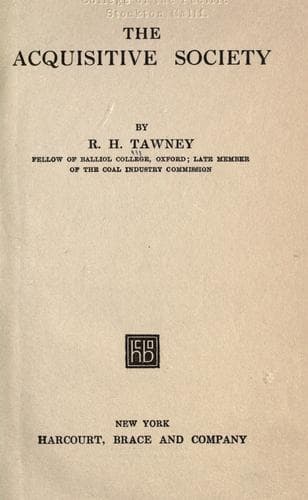
The Acquisitive SocietyTawney, R. H. (Richard Henry)
Philosophy
The Acquisitive Society
Tawney, R. H. (Richard Henry)
Economics; Industries; Social problems
Nor is their economic interest identical, as is sometimes assumed, with
that of the general public. A society is rich when material goods,
including capital, are cheap, and human beings dear: indeed the word
"riches" has no other meaning. The interest of those who own the
property used in industry, though not, of course, of the managers who
administer industry and who themselves are servants, and often very
ill-paid servants at that, is that their capital should be dear and
human beings cheap. Hence, if the industry is such as to yield a
considerable return, or if one unit in the industry, owing to some
special advantage, produces more cheaply than its neighbors, while
selling at the same price, or if a revival of trade raises prices, or
if supplies are controlled by one of the combines which are now the
rule in many of the more important industries, the resulting surplus
normally passes neither to the managers, nor to the other employees,
nor to the public, but to the shareholders. Such an arrangement is
preposterous in the literal sense of being the reverse of that which
would be established by considerations of equity and common sense, and
gives rise (among other things) to what is called "the struggle between
labor and capital." The phrase is apposite, since it is as absurd as
the relations of which it is intended to be a description. To deplore
"ill-feeling" or to advocate {99} "harmony" between "labor and capital"
is as rational as to lament the bitterness between carpenters and
hammers or to promote a mission for restoring amity between mankind and
its boots. The only significance of these _cliches_ is that their
repetition tends to muffle their inanity, even to the point of
persuading sensible men that capital "employs" labor, much as our pagan
ancestors imagined that the other pieces of wood and iron, which they
deified in their day, sent their crops and won their battles. When men
have gone so far as to talk as though their idols have come to life, it
is time that some one broke them. Labor consists of persons, capital
of things. The only use of things is to be applied to the service of
persons. The business of persons is to see that they are there to use,
and that no more than need be is paid for using them.
Public-domain text, read in full here on John Shaqi.
Reviews
Reviews
No reviews yet
Be the first to share your thoughts on this work.
Elsewhere in the archive
Join the Discussion
Join the discussion
Sign in to leave a comment or review.
Sign InorCreate an account