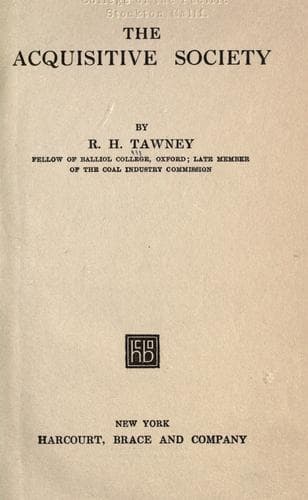
The Acquisitive SocietyTawney, R. H. (Richard Henry)
Philosophy
The Acquisitive Society
Tawney, R. H. (Richard Henry)
Economics; Industries; Social problems
proposed that employers should be paid a fixed salary, and a fixed rate
of {104} interest on their capital, but that all surplus profits should
be pooled and administered by a central body representing employers and
workers. The fifth has repeatedly been practised by municipalities,
and somewhat less often by national governments.
Which of these alternative methods of removing industry from the
control of the property-owner is adopted is a matter of expediency to
be decided in each particular case. "Nationalization," therefore,
which is sometimes advanced as the only method of extinguishing
proprietary rights, is merely one species of a considerable genus. It
can be used, of course, to produce the desired result. But there are
some industries, at any rate, in which nationalization is not necessary
in order to bring it about, and since it is at best a cumbrous process,
when other methods are possible, other methods should be used.
Nationalization is a means to an end, not an end in itself. Properly
conceived its object is not to establish state management of industry,
but to remove the dead hand of private ownership, when the private
owner has ceased to perform any positive function. It is unfortunate,
therefore, that the abolition of obstructive property rights, which is
indispensable, should have been identified with a single formula, which
may be applied with advantage in the special circumstances of some
industries, but need not necessarily be applied in all. Ownership is
not a right, but a bundle of rights, and it is possible to strip them
off piecemeal as well as to strike them off simultaneously. The
ownership of capital involves, as we have said, three main claims; the
right to interest as the price of capital, the right to {105} profits,
and the right to control, in virtue of which managers and workmen are
the servants of shareholders. These rights in their fullest degree are
not the invariable accompaniment of ownership, nor need they
necessarily co-exist. The ingenuity of financiers long ago devised
methods of grading stock in such a way that the ownership of some
carries full control, while that of others does not, that some bear all
the risk and are entitled to all the profits, while others are limited
in respect to both. All are property, but not all carry proprietary
rights of the same degree.
Public-domain text, read in full here on John Shaqi.
Reviews
Reviews
No reviews yet
Be the first to share your thoughts on this work.
Elsewhere in the archive
Join the Discussion
Join the discussion
Sign in to leave a comment or review.
Sign InorCreate an account