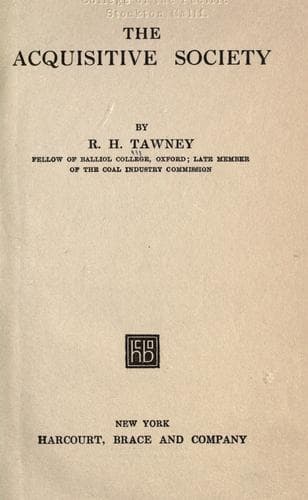
The Acquisitive SocietyTawney, R. H. (Richard Henry)
Philosophy
The Acquisitive Society
Tawney, R. H. (Richard Henry)
Economics; Industries; Social problems
So here again, unless we are prepared to re-establish some form of
forced labor, we reach an impasse. But it is an impasse only in so
long as we regard the proprietary rights of those who own the capital
used in industry as absolute and an end in themselves. If, instead of
assuming that all property, merely because it is property, is equally
sacred, we ask what is the _purpose_ for which capital is used, what is
its _function_, we shall realize that it is not an end but a means to
an end, and that its function is to serve and assist (as the economists
tell us) the labor of human beings, not the function of human beings to
serve those who happen to own it. And from this truth two consequences
follow. The first is that since capital is a thing, which ought to be
used to help industry as a man may use a bicycle to get more quickly to
his work, it ought, when it is employed, to be employed on the cheapest
terms possible. The second is that those who own it should no more
control production than a man who lets a house controls the meals which
shall be cooked in the kitchen, or the man who lets a boat the speed at
which the rowers shall pull. In other words, capital should always be
got at cost price, which means, unless the State finds it wise, as it
very well may, to own the capital used in certain industries, it should
be paid the lowest interest {103} for which it can be obtained, but
should carry no right either to residuary dividends or to the control
of industry.
There are, in theory, five ways by which the control of industry by the
agents of private property-owners can be terminated. They may be
expropriated without compensation. They may voluntarily surrender it.
They may be frozen out by action on the part of the working
_personnel_, which itself undertakes such functions, if any, as they
have performed, and makes them superfluous by conducting production
without their assistance. Their proprietary interest may be limited or
attenuated to such a degree that they become mere _rentiers_, who are
guaranteed a fixed payment analogous to that of the debenture-holder,
but who receive no profits and bear no responsibility for the
organization of industry. They may be bought out. The first
alternative is exemplified by the historical confiscations of the past,
such as, for instance, by the seizure of ecclesiastical property by the
ruling classes of England, Scotland and most other Protestant states.
The second has rarely, if ever, been tried--the nearest approach to it,
perhaps, was the famous abdication of August 4th, 1789. The third is
the method apparently contemplated by the building guilds which are now
in process of formation in Great Britain. The fourth method of
treating the capitalist is followed by the co-operative movement. It
is also that proposed by the committee of employers and trade-unionists
in the building industry over which Mr. Foster presided, and which
Public-domain text, read in full here on John Shaqi.
Reviews
Reviews
No reviews yet
Be the first to share your thoughts on this work.
Elsewhere in the archive
Join the Discussion
Join the discussion
Sign in to leave a comment or review.
Sign InorCreate an account