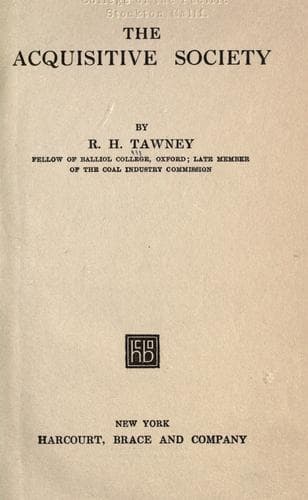
The Acquisitive SocietyTawney, R. H. (Richard Henry)
Philosophy
The Acquisitive Society
Tawney, R. H. (Richard Henry)
Economics; Industries; Social problems
So here we have the majority of a body of practical men, who care
nothing for socialist theories, proposing to establish "organized
Public Service in the Building Industry," recommending, in short, that
their industry shall be turned into a profession. And they do it, it
{109} will be observed, by just that functional organization, just that
conversion of full proprietary rights into a mortgage secured (as far
as efficient firms are concerned) on the industry as a whole, just that
transference of the control of production from the owner of capital to
those whose business is production, which we saw is necessary if
industry is to be organized for the performance of service, not for the
pecuniary advantage of those who hold proprietary rights. Their Report
is of the first importance as offering a policy for attenuating private
property in capital in the important group of industries in which
private ownership, in one form or another, is likely for some
considerable time to continue, and a valuable service would be rendered
by any one who would work out in detail the application of its
principle to other trades.
Not, of course, that this is the only way, or in highly capitalized
industries the most feasible way, in which the change can be brought
about. Had the movement against the control of production by property
taken place before the rise of limited companies, in which ownership is
separated from management, the transition to the organization of
industry as a profession might also have taken place, as the employers
and workmen in the building trade propose that it should, by limiting
the rights of private ownership without abolishing it. But that is not
what has actually happened, and therefore the proposals of the building
trade are not of universal application. It is possible to retain
private ownership in building and in industries like building, {110}
while changing its character, precisely because in building the
employer is normally not merely an owner, but something else as well.
He is a manager; that is, he is a workman. And because he is a
workman, whose interests, and still more whose professional spirit as a
workman may often outweigh his interests and merely financial spirit as
an owner, he can form part of the productive organization of the
industry, after his rights as an owner have been trimmed and limited.
Public-domain text, read in full here on John Shaqi.
Reviews
Reviews
No reviews yet
Be the first to share your thoughts on this work.
Elsewhere in the archive
Join the Discussion
Join the discussion
Sign in to leave a comment or review.
Sign InorCreate an account