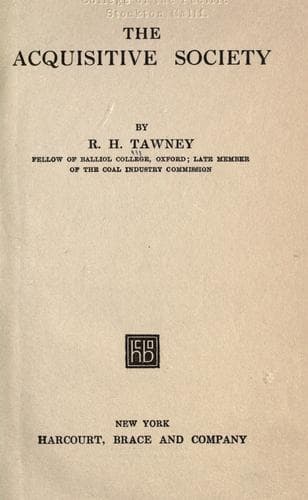
The Acquisitive SocietyTawney, R. H. (Richard Henry)
Philosophy
The Acquisitive Society
Tawney, R. H. (Richard Henry)
Economics; Industries; Social problems
But that dual position is abnormal, and in the highly organized
industries is becoming more abnormal every year. In coal, in cotton,
in ship-building, in many branches of engineering the owner of capital
is not, as he is in building, an organizer or manager. His connection
with the industry and interest in it is purely financial. He is an
owner and nothing more. And because his interest is merely financial,
so that his concern is dividends and production only as a means to
dividends, he cannot be worked into an organization of industry which
vests administration in a body representing all grades of producers, or
producers and consumers together, for he has no purpose in common with
them; so that while joint councils between workers and managers may
succeed, joint councils between workers and owners or agents of owners,
like most of the so-called Whitley Councils, will not, because the
necessity for the mere owner is itself one of the points in dispute.
The master builder, who owns the capital used, can be included, not
_qua_ capitalist, but _qua_ builder, if he surrenders some of the
rights of ownership, as the Building Industry Committee proposed that
he should. But {111} if the shareholder in a colliery or a shipyard
abdicates the control and unlimited profits to which, _qua_ capitalist,
he is at present entitled, he abdicates everything that makes him what
he is, and has no other standing in the industry. He cannot share,
like the master builder, in its management, because he has no
qualifications which would enable him to do so. His object is profit;
and if industry is to become, as employers and workers in the building
trade propose, an "organized public service," then its subordination to
the shareholder whose object is profit, is, as they clearly see,
precisely what must be eliminated. The master builders propose to give
it up. They can do so because they have their place in the industry in
virtue of their function as workmen. But if the shareholder gave it
up, he would have no place at all.
Public-domain text, read in full here on John Shaqi.
Reviews
Reviews
No reviews yet
Be the first to share your thoughts on this work.
Elsewhere in the archive
Join the Discussion
Join the discussion
Sign in to leave a comment or review.
Sign InorCreate an account