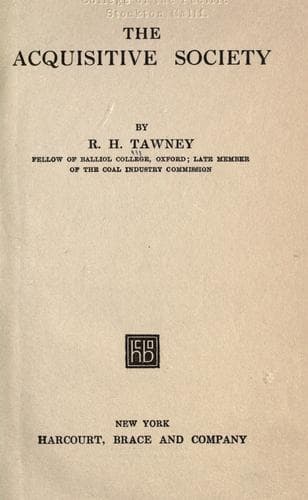
The Acquisitive SocietyTawney, R. H. (Richard Henry)
Philosophy
The Acquisitive Society
Tawney, R. H. (Richard Henry)
Economics; Industries; Social problems
Hence in coal mining, where ownership and management are sharply
separated, the owners will not admit the bare possibility of any system
in which the control of the administration of the mines is shared
between the management and the miners. "I am authorized to state on
behalf of the Mining Association," Lord Gainford, the chief witness on
behalf of the mine-owners, informed the Coal Commission, "that if the
owners are not to be left complete executive control they will decline
to accept the responsibility for carrying on the industry."[2] So the
mine-owners blow away in a sentence the whole body of plausible
make-believe which rests on the idea that, while private ownership
remains {112} unaltered, industrial harmony can be produced by the
magic formula of joint control. And they are right. The
representatives of workmen and shareholders, in mining and in other
industries, can meet and negotiate and discuss. But joint
administration of the shareholders' property by a body representing
shareholders and workmen is impossible, because there is no purpose in
common between them. For the only purpose which could unite all
persons engaged in industry, and overrule their particular and
divergent interests, is the provision of service. And the object of
shareholders, the whole significance and _metier_ of industry to them,
is not the provision of service but the provision of dividends.
In industries where management is divorced from ownership, as in most
of the highly organized trades it is to-day, there is no obvious
halfway house, therefore, between the retention of the present system
and the complete extrusion of the capitalist from the control of
production. The change in the character of ownership, which is
necessary in order that coal or textiles and ship-building may be
organized as professions for the service of the public, cannot easily
spring from within. The stroke needed to liberate them from the
control of the property-owner must come from without. In theory it
might be struck by action on the part of organized workers, who would
abolish residuary profits and the right of control by the mere
procedure of refusing to work as long as they were maintained, on the
historical analogy offered by peasants who have destroyed {113}
predatory property in the past by declining to pay its dues and admit
its government, in which case Parliament would intervene only to
register the community's assent to the _fait accompli_. In practice,
however, the conditions of modern industry being what they are, that
course, apart from its other disadvantages, is so unlikely to be
attempted, or, if attempted, to succeed, that it can be neglected. The
alternative to it is that the change in the character of property
should be affected by legislation in virtue of which the rights of
ownership in an industry are bought out simultaneously.
Public-domain text, read in full here on John Shaqi.
Reviews
Reviews
No reviews yet
Be the first to share your thoughts on this work.
Elsewhere in the archive
Join the Discussion
Join the discussion
Sign in to leave a comment or review.
Sign InorCreate an account