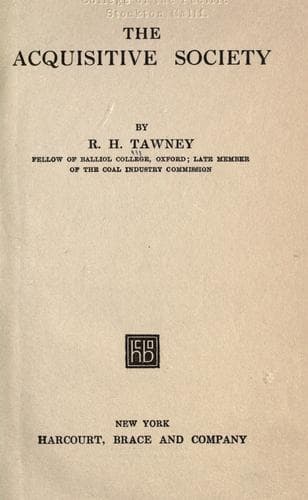
The Acquisitive SocietyTawney, R. H. (Richard Henry)
Philosophy
The Acquisitive Society
Tawney, R. H. (Richard Henry)
Economics; Industries; Social problems
It is commonly assumed by controversialists that the organization and
management of a nationalized industry must, for some undefined reason,
be similar to that of the post-office. One might as reasonably suggest
that the pattern exemplar of private enterprise must be the Steel
Corporation or the Imperial Tobacco Company. The administrative
systems obtaining in a society which has nationalized its foundation
industries will, in fact, be as various as in one that resigns them to
private ownership; and to discuss their relative advantages without
defining what particular type of each is the subject of reference is
to-day as unhelpful as to approach a modern political problem in terms
of the Aristotelian classification of constitutions. The highly
abstract dialectics as to "enterprise," "initiative," "bureaucracy,"
"red tape," "democratic control," "state management," which fill the
press of countries occupied with industrial problems, really belong to
the dark ages of economic thought. The first task of the student,
whatever his personal conclusions, is, it may be suggested, to
contribute what he can to the restoration of sanity by insisting that
instead of the argument being conducted with the counters of a highly
inflated and rapidly depreciating verbal currency, the exact situation,
{117} in so far as is possible, shall be stated as it is; uncertainties
(of which there are many) shall be treated as uncertain, and the
precise meaning of alternative proposals shall be strictly defined.
Not the least of the merits of Mr. Justice Sankey's report was that, by
stating in great detail the type of organization which he recommended
for the Coal Industry, he imparted a new precision and reality into the
whole discussion. Whether his conclusions are accepted or not, it is
from the basis of clearly defined proposals such as his that the future
discussion of these problems must proceed. It may not find a solution.
It will at least do something to create the temper in which alone a
reasonable solution can be sought.
Public-domain text, read in full here on John Shaqi.
Reviews
Reviews
No reviews yet
Be the first to share your thoughts on this work.
Elsewhere in the archive
Join the Discussion
Join the discussion
Sign in to leave a comment or review.
Sign InorCreate an account