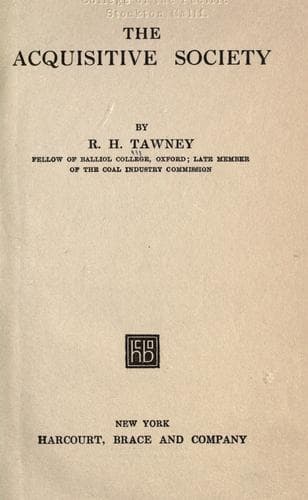
The Acquisitive SocietyTawney, R. H. (Richard Henry)
Philosophy
The Acquisitive Society
Tawney, R. H. (Richard Henry)
Economics; Industries; Social problems
That system might be lauded as efficient or denounced as inhuman. But,
at least, as its admirers were never tired of pointing out, it worked.
And, like the Prussian State, which alike in its virtues and
deficiencies it not a little resembled, as long as it worked it
survived denunciations of its methods, as a strong man will throw off a
disease. But to-day it is ceasing to have even the qualities of its
defects. It is ceasing to be efficient. It no longer secures the
ever-increasing output of wealth which it offered in its golden prime,
and which enabled it to silence criticism by an imposing spectacle of
material success. Though it still works, it works unevenly, amid
constant friction and jolts and stoppages, without the confidence of
the public and without full confidence even in itself, a tyrant who
must intrigue and cajole where formerly he commanded, a gaoler who, if
not yet {141} deprived of whip, dare only administer moderate
chastisement, and who, though he still protests that he alone can keep
the treadmill moving and get the corn ground, is compelled to surrender
so much of his authority as to make it questionable whether he is worth
his keep. For the instruments through which Capitalism exercised
discipline are one by one being taken from it. It cannot pay what
wages it likes or work what hours it likes. In well-organized
industries the power of arbitrary dismissal, the very center of its
authority, is being shaken, because men will no longer tolerate a
system which makes their livelihood dependent on the caprices of an
individual. In all industries alike the time is not far distant when
the dread of starvation can no longer be used to cow dissatisfied
workers into submission, because the public will no longer allow
involuntary unemployment to result in starvation.
Public-domain text, read in full here on John Shaqi.
Reviews
Reviews
No reviews yet
Be the first to share your thoughts on this work.
Elsewhere in the archive
Join the Discussion
Join the discussion
Sign in to leave a comment or review.
Sign InorCreate an account