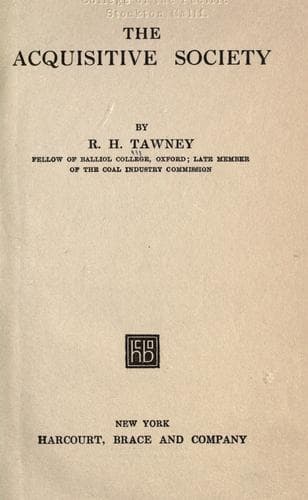
The Acquisitive SocietyTawney, R. H. (Richard Henry)
Philosophy
The Acquisitive Society
Tawney, R. H. (Richard Henry)
Economics; Industries; Social problems
So Capitalism no longer secures strenuous work by fear, for it is
ceasing to be formidable. And it cannot secure it by respect, for it
has ceased to be respected. And the very victories by which it seeks
to reassert its waning prestige are more disastrous than defeats.
Employers may congratulate themselves that they have maintained intact
their right to freedom of management, or opposed successfully a demand
for public ownership, or broken a movement for higher wages and shorter
hours. But what is success in a trade dispute or in a political
struggle is often a defeat in the workshop: the workmen may have lost,
but it does not follow that their employers, still less that the
public, which is principally composed of workmen, have won. For the
object of industry is to produce goods, and to produce them at the
lowest cost in human effort. {143} But there is no alchemy which will
secure efficient production from the resentment or distrust of men who
feel contempt for the order under which they work. It is a commonplace
that credit is the foundation of industry. But credit is a matter of
psychology, and the workman has his psychology as well as the
capitalist. If confidence is necessary to the investment of capital,
confidence is not less necessary to the effective performance of labor
by men whose sole livelihood depends upon it. If they are not yet
strong enough to impose their will, they are strong enough to resist
when their masters would impose theirs. They may work rather than
strike. But they will work to escape dismissal, not for the greater
glory of a system in which they do not believe; and, if they are
dismissed, those who take their place will do the same.
That this is one cause of a low output has been stated both by
employers and workers in the building industry, and by the
representatives of the miners before the Coal Commission. It was
reiterated with impressive emphasis by Mr. Justice Sankey. Nor is it
seriously contested by employers themselves. What else, indeed, do
their repeated denunciations of "restriction of output" mean except
that they have failed to organize industry so as to secure the
efficient service which it is their special function to provide? Nor
is it appropriate to the situation to indulge in full-blooded
denunciations of the "selfishness" of the working classes. "To draw an
indictment against a whole nation" is a procedure which is as
impossible in industry as it is in politics. Institutions must be
adapted to human nature, not {144} human nature to institutions. If
the effect of the industrial system is such that a large and increasing
number of ordinary men and women find that it offers them no adequate
motive for economic effort, it is mere pedantry to denounce men and
women instead of amending the system.
Public-domain text, read in full here on John Shaqi.
Reviews
Reviews
No reviews yet
Be the first to share your thoughts on this work.
Elsewhere in the archive
Join the Discussion
Join the discussion
Sign in to leave a comment or review.
Sign InorCreate an account